AgileX Hunter 2.0 security patrol payload: PTZ, thermal, speaker and light
Updated 2026-11-03 · YUANZHI ROBOTICS engineering team
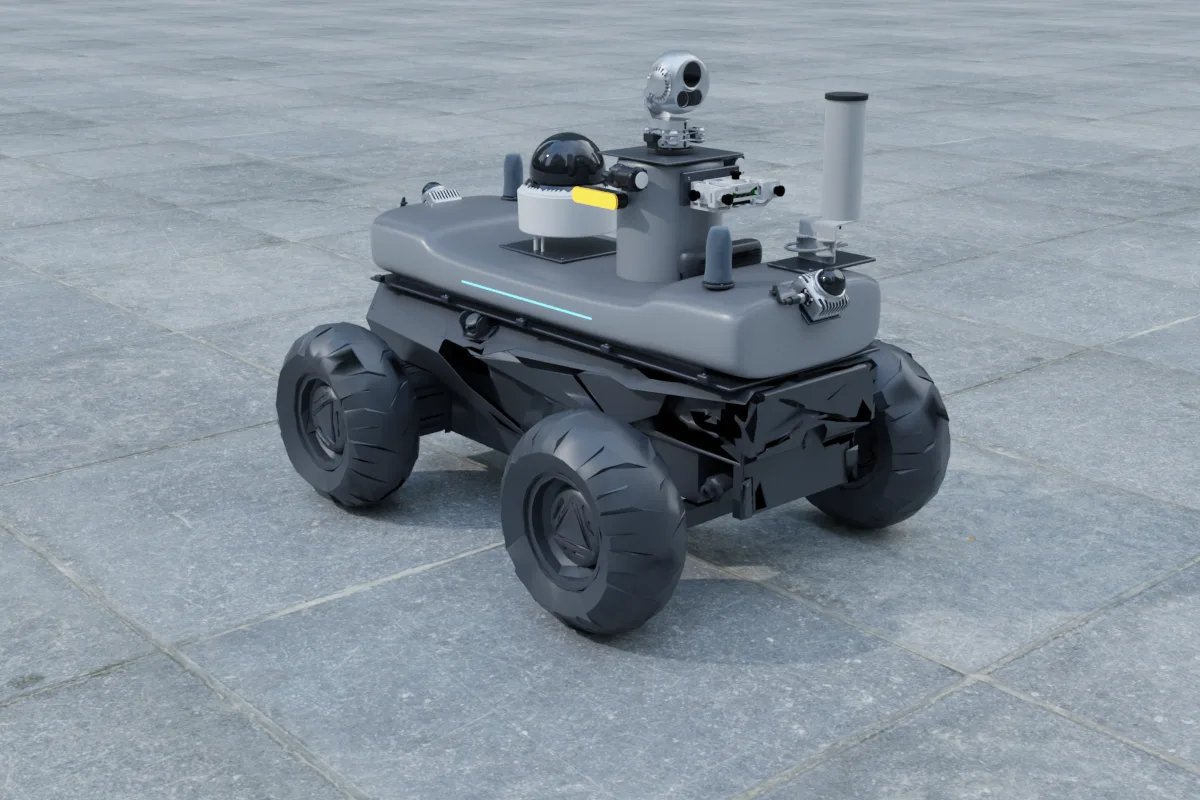
A security patrol payload for an AgileX Hunter 2.0 normally combines four things: a pan-tilt camera with a thermal channel for detection at night, a 360° LiDAR for localization on the patrol route, a speaker and light unit so the robot can challenge and deter on site, and a cellular link that streams video to the control room. The Hunter 2.0 (about 980 × 745 × 380 mm, about 65 kg, rated for about 150 kg of payload) can carry all of this, including heavy industrial PTZ heads. The real design questions are which PTZ class you need, how high to mount it, and how to power and network everything from the robot battery.
Why the Hunter 2.0 suits patrol work
The Hunter 2.0 uses Ackermann (car-like) steering rather than skid steering. On long, repeated routes over paved site roads, car parks and perimeter lanes this means less tyre scrub, smoother video from the pan-tilt head and more predictable path following than a skid-steer base of similar size. The trade-off is a larger turning radius, so routes with tight indoor corners or narrow gates need to be checked before you commit. If your patrol is mostly indoors or on rough ground, compare it with a skid-steer UGV first; our Husky A200 vs Hunter 2.0 comparison covers that choice.
Choosing the PTZ: compact gimbal or heavy pan-tilt head
The camera head is the biggest decision because it sets weight, power and detection range. Two classes cover most patrol projects:
| Option | Example in our catalog | Weight | Power | Best for |
|---|---|---|---|---|
| Compact dual-spectrum gimbal | Hikvision HM-TD5737T-4/W | about 2 kg | about 20 W | Campus, factory and car-park patrol where targets are within a few tens of meters |
| Dual-spectrum mini pan-tilt | Hikvision DS-2TD5566T-15/V2 (thermal 640 × 512, visible 1080p) | about 4.5 kg | about 18 W | Sites that need a higher-resolution thermal channel and temperature measurement |
| Heavy-duty thermal + visible pan-tilt | Dahua DH-TPC-PT8X20 | about 18 kg | about 70 W | Long perimeters, open yards and fence lines where long-range detection matters more than weight |
On many smaller UGVs the 18 kg head would be out of the question; on the Hunter 2.0 it fits within the rated payload with a large margin. What changes is the mounting: a heavy head must sit low and close to the center of the chassis, on a stiff frame, and it needs its own power rail sized for start-up current. A compact gimbal can go on a short mast for a better line of sight over parked cars and hedges. Our guide to thermal and dual-spectrum gimbals explains the thermal resolution and lens questions in more detail.
Thermal for night detection
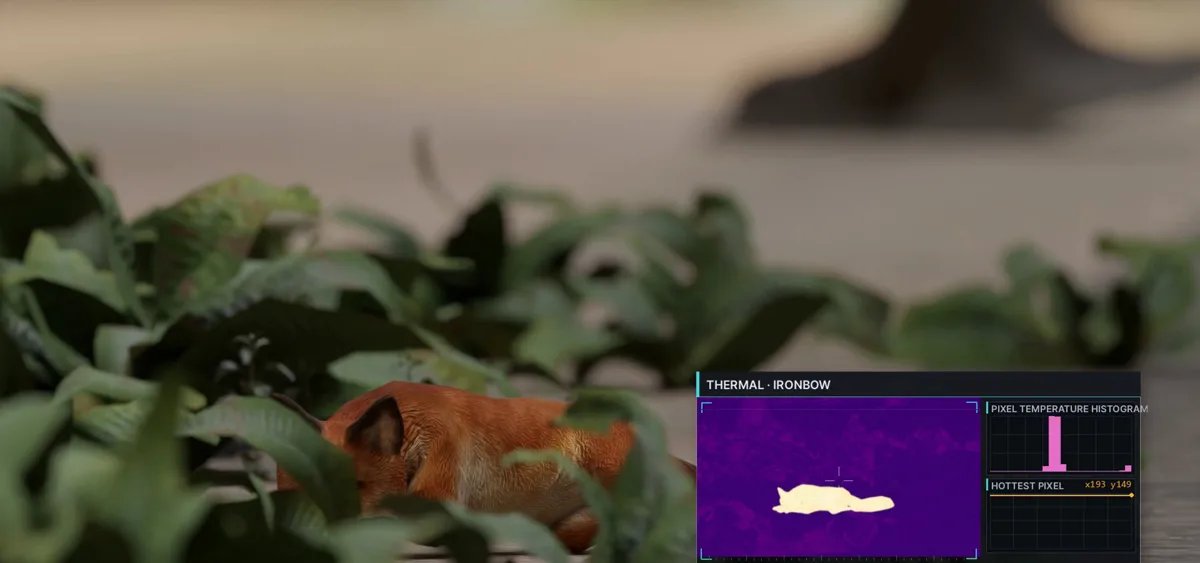
Most patrol work happens at night, and a visible camera with IR illumination only covers a short range. A thermal channel picks out people, vehicles and animals by heat contrast with no light at all, which is why patrol payloads almost always use a dual-spectrum head rather than a plain visible PTZ. If you need a fixed, forward-looking thermal view in addition to the PTZ (for example for obstacle awareness or a second viewing direction), a networked thermal core such as the Guide IPT640M (640 × 512) can be built into the payload enclosure.
Speaker, light and alarm
Detection alone does not stop an intruder; the operator needs to challenge them. A typical integrated speaker and LED light unit, network-controlled, weighs around 650 g and draws about 30 W (roughly a 20 W loudspeaker plus a 10 W light in the reference unit we design around). Add a small red/blue strobe with a buzzer (around 160 g, about 5 W) if the site wants a visible warning while the robot moves. Point the speaker and light the same way as the PTZ's default view, so that when the operator talks to someone, the light falls where the camera is looking. Keep the loudspeaker away from any microphone array, or two-way audio will feed back.
LiDAR and navigation on the patrol route
A patrol robot must repeat the same route reliably, day after day, in rain and in the dark. A 360° LiDAR such as the Livox Mid-360 or Mid-360S (265 g, 6.5 W, 360° × 59° field of view; the Mid-360S is specified to 100 m, the Mid-360 to 70 m) gives LiDAR-inertial localization that does not depend on lighting. Mount it where the PTZ, mast and antennas do not block its view; on the Hunter 2.0 that usually means the front of the top deck, slightly raised. For open outdoor sites with few walls or structures, adding RTK GNSS makes localization more robust; see our RTK GNSS guide, which applies equally to UGVs.
Compute and video link
A Jetson Orin NX 16GB (up to 157 TOPS, budget up to about 40 W) can run localization, route following, person and vehicle detection on the PTZ stream, and video encoding at the same time. For remote viewing a 5G module such as the Quectel RM520N-GL gives the uplink needed for live video to the control room; plan antenna positions so they are not shadowed by the PTZ or mast. The 5G remote control guide covers latency and antenna placement.
Power and weight budget
Add up the peak draw before choosing DC-DC converters. A compact-gimbal patrol payload (gimbal about 20 W, speaker-light about 30 W, LiDAR 6.5 W, compute up to about 40 W, plus 5G and networking) lands around 100 W at peak. Swapping in the heavy pan-tilt head adds about 50 W more and about 16 kg. Weight is easy on the Hunter 2.0, but every watt comes off patrol time, so size the payload to the detection range you really need. The method is in our weight and power budget guide.
Build it with YUANZHI ROBOTICS
We design and build complete patrol payloads for the Hunter 2.0 and other UGVs: mounting structure and enclosure, power distribution, wiring, ROS 2 drivers, route patrol navigation and the operator interface for video, talk-back and alarms. Start in the online configurator with the Hunter 2.0 platform page, or read more about our UGV payload, inspection robot and robot autonomy services, then send us a request for a quote.
FAQ
Can an AgileX Hunter 2.0 be used as a security patrol robot?
Yes. The Hunter 2.0 (about 65 kg, rated for about 150 kg of payload) uses Ackermann steering, which suits long repeated routes on paved roads, car parks and perimeter lanes. Fitted with a dual-spectrum PTZ, LiDAR, speaker and light and a 5G link it works as an outdoor patrol robot. Check tight corners and gates, as its turning radius is larger than a skid-steer UGV.
Which PTZ camera should I put on a patrol UGV?
For campus and car-park patrol a compact dual-spectrum gimbal such as the Hikvision HM-TD5737T-4/W (about 2 kg, about 20 W) is usually enough. For long perimeters and open yards a heavy-duty thermal plus visible pan-tilt such as the Dahua DH-TPC-PT8X20 (about 18 kg, about 70 W) gives longer detection range, and the Hunter 2.0 can carry it if it is mounted low and centered.
Does a security patrol robot need a thermal camera?
In practice yes, because most patrol happens at night. A thermal channel detects people, vehicles and animals by heat with no lighting, while a visible camera with IR illumination only covers a short range. That is why patrol payloads normally use a dual-spectrum (visible plus thermal) head.
How much power does a UGV security payload draw?
A compact-gimbal patrol payload with speaker and light, a Livox Mid-360 LiDAR, a Jetson Orin NX 16GB and a 5G module draws around 100 W at peak. A heavy 70 W pan-tilt head adds about 50 W. All of it comes from the robot battery, so it directly reduces patrol time.
Who can build a security patrol payload for an AgileX Hunter?
YUANZHI ROBOTICS designs and builds patrol payloads for the Hunter 2.0 and other UGVs, including the mounting structure, power and wiring, ROS 2 drivers, route patrol navigation and the operator interface for video, talk-back and alarms. You can configure a payload online and request a quote.