Who can build a custom inspection robot for a specific plant or tunnel?
Updated 2026-11-13 · YUANZHI ROBOTICS engineering team
Three kinds of teams build inspection robots for a specific site: the robot maker, if it sells a turnkey inspection product; a systems integrator that adds sensors and site software to a commercial robot dog, UGV or drone; or your own engineering team. For one plant, substation, cable tunnel or utility corridor, the practical route is almost always a proven commercial base robot plus an integrator who designs the payload and writes the site software. Designing a new chassis only makes sense when no commercial robot can physically move through the site.
The three options in practice
| Builder | What you get | Strength | Limit |
|---|---|---|---|
| Robot maker (turnkey inspection product) | Robot, sensor head and inspection software from one vendor | One contract, mature software for standard tasks | Sensor choice and software changes follow the vendor's roadmap; usually the highest price |
| Systems integrator on a commercial base | A commercial quadruped, UGV or drone with a payload and software built for your site | Sensors chosen per task, software adapted to your routes and data systems | Quality depends on the integrator; you must define acceptance criteria clearly |
| In-house team | Whatever your engineers build on a robot you buy | Full control and knowledge stays in the company | Slowest start; needs mechanical, electrical, ROS 2 and field-test skills at the same time |
A fourth option, a bespoke chassis from a design house, is worth considering only for unusual geometry such as pipes, ducts or very narrow cable trays where no commercial legged or wheeled robot fits.
Start from the site, not from the robot
Whoever builds it, the first deliverable should be a written site description. A good builder will ask for these before naming a robot:
- Terrain along the route: stairs and their steepness, steel gratings, kerbs, door thresholds, cable covers, standing water, slopes, and the narrowest passage.
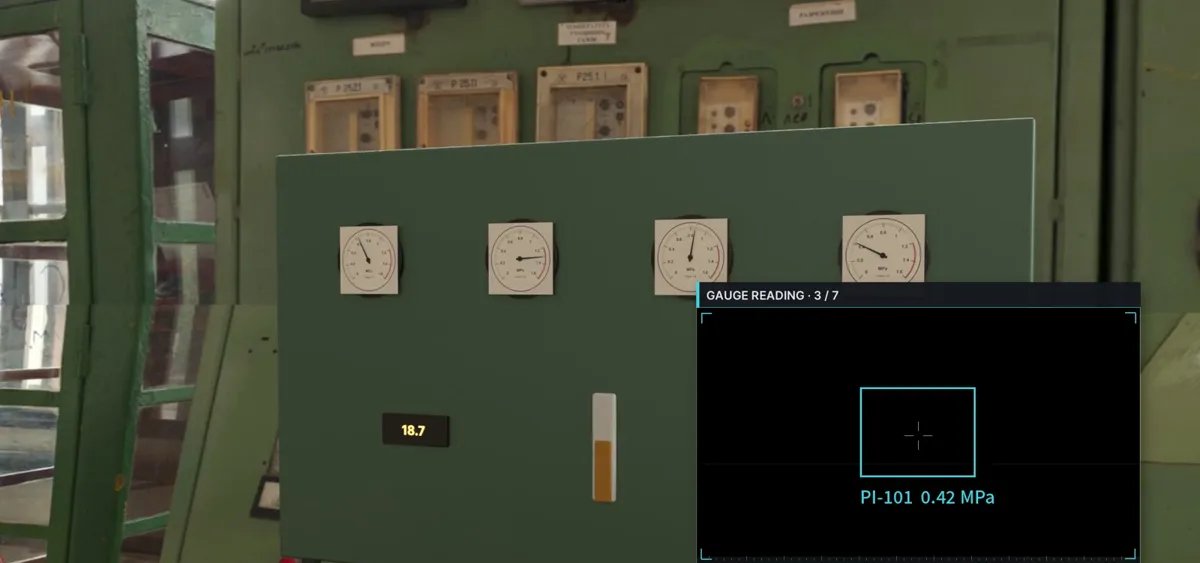
- What must be checked: analog gauges, indicator lamps, valve positions, hot spots, gas concentration, abnormal sound or leaks. Each task decides a sensor.
- How often and how unattended: a daily round with an operator nearby is a different project from 24/7 runs with autonomous docking.
- Communications: Wi-Fi coverage, private or public 5G, or no signal at all, which is common in tunnels.
- Hazardous-area classification: if any zone requires explosion-protected equipment, the base robot and every payload part must be certified for it. Standard commercial robots are not, so settle this first.
- Where the data goes: a dashboard, a CMMS or SCADA system, or reports by e-mail.
Matching the site to a platform
| Site condition | Platform type that usually fits | Examples |
|---|---|---|
| Stairs, gratings, mixed indoor and outdoor walkways | Quadruped | Unitree B2, DEEP Robotics X30, Boston Dynamics Spot, ANYbotics ANYmal D |
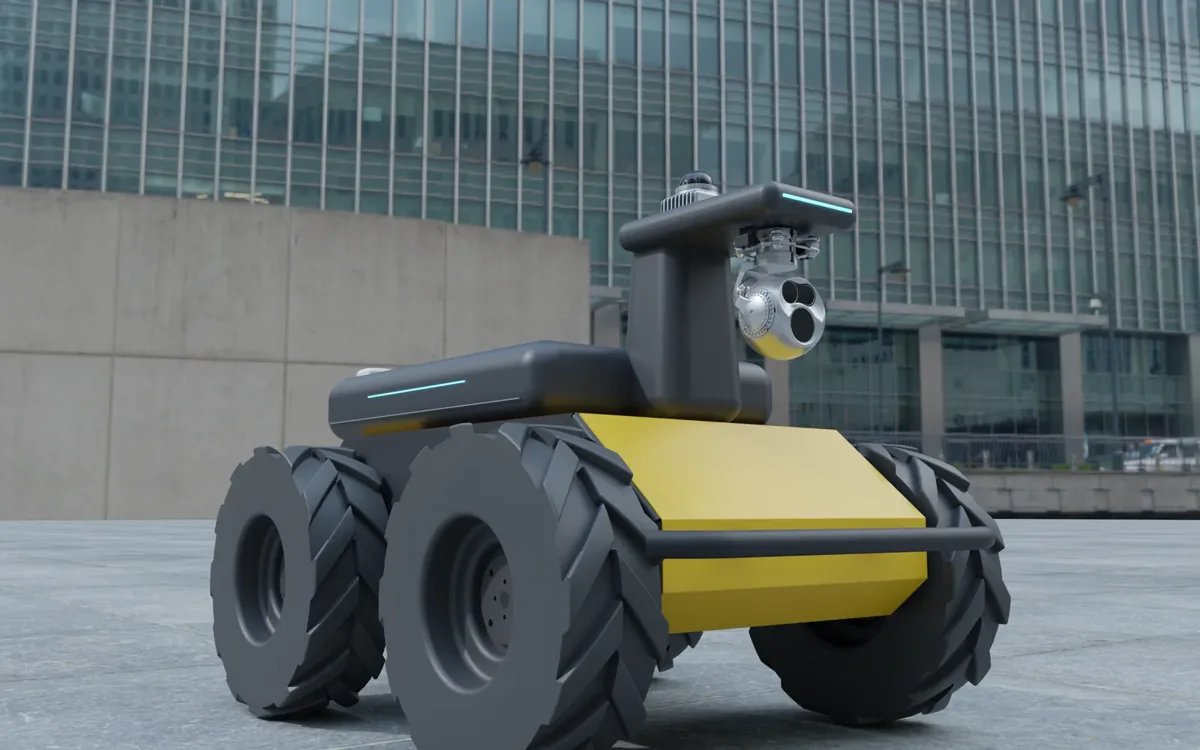
| Long flat corridors, utility tunnels, warehouse aisles | Wheeled UGV or wheel-legged robot | Clearpath Husky A200, AgileX Tracer 2.0, Unitree B2-W, DEEP Robotics M20 |
| Rough ground, mud, gravel yards | Tracked UGV | AgileX Bunker, Bunker Pro |
| Roofs, tall structures, large outdoor areas | Drone | DJI Matrice 350 RTK, Matrice 4TD with dock |
Large sites often end up with two robot types, for example a quadruped for the plant rooms with stairs and a drone for roofs and stacks. See our comparisons UGV or robot dog for industrial inspection and robot dog or drone for site inspection.
What the builder should deliver
- Site survey and route plan with every inspection point, the view each point needs, and the terrain at each step.
- Payload design: mounting, enclosure, DC-DC power from the robot battery and the data links. As a reference, a common core set from our catalog is a Livox Mid-360 LiDAR (265 g, 6.5 W), a Hikvision HM-TD5737T-4/W dual-spectrum gimbal (2.0 kg, 20 W) and an NVIDIA Jetson Orin NX 16GB (up to 40 W, 157 TOPS), roughly 2.3 kg and 66.5 W before mounts, cables and enclosure.
- Mapping and navigation: a map of the site, routes between inspection points, obstacle handling and recovery behaviour.
- Inspection tasks: gauge reading, thermal thresholds, gas alarms or sound checks, each with a defined pass and fail output.
- Data delivery to your system and an operator interface.
- Acceptance test on site against criteria written into the contract.
Tunnels need extra attention
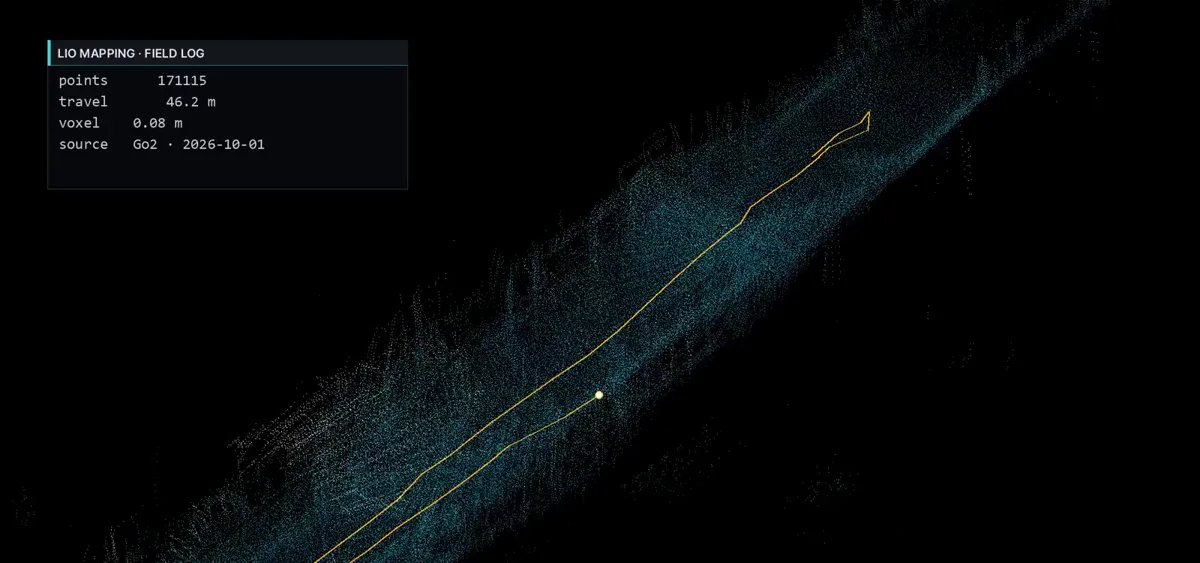
Long tunnels and utility corridors are harder than they look. Repetitive walls give a LiDAR SLAM system few distinct features, so position can drift along the tunnel axis. Builders handle this with loop closures where the layout allows, fixed markers or tags at known positions, wheel or leg odometry fusion, and mapping in shorter segments joined at known points. Radio is the second issue: plan for store-and-forward of inspection data when the link drops, and decide what the robot does if it loses contact. Ask the builder how they have solved both, not whether.
Questions to ask before you choose
- Have you run this software on the same base robot, and can you show a recorded map or route?
- Who owns the site-specific software, and is the source code or a licence included?
- Where is the map and inspection data stored, and can it stay on our premises?
- What is not included: base robot, spare batteries, docking station, network equipment, on-site travel?
- Which acceptance tests will we run on site, and what happens if one fails?
For more on choosing an integrator for robot dogs specifically, see who can integrate a custom payload on my robot dog.
Where YUANZHI ROBOTICS fits
We are the integrator option: we design payloads and inspection software on commercial robot dogs, UGVs and drones rather than building new chassis. You can assemble a payload and see its weight and power on our online payload configurator, look at platform pages such as the Unitree B2, DEEP Robotics X30 and Clearpath Husky A200, or read about our inspection robot development, autonomy software, UGV payloads and drone payloads. Send us your site description and we will reply with a platform recommendation and a feature list.
FAQ
Who builds custom inspection robots for industrial plants?
Robot makers with turnkey inspection products, systems integrators that fit sensors and inspection software onto commercial robot dogs, UGVs or drones, and in-house robotics teams. Most single-site projects use a commercial base robot plus an integrator.
Should I build a robot from scratch for tunnel inspection?
Usually not. Commercial quadrupeds, wheeled and tracked UGVs already solve locomotion, batteries and motor control. The site-specific work is the sensor payload, localisation in long corridors, communications and the inspection software.
What does a custom inspection robot project include?
A site survey and route definition, platform selection, payload design (mounting, power, data), mapping and route software, inspection tasks such as gauge reading or thermal alarms, data delivery to your systems, and an acceptance test on site.
Is a robot dog or a wheeled robot better for plant inspection?
A robot dog suits stairs, gratings, kerbs and cluttered walkways. A wheeled or tracked UGV suits long flat routes, heavier payloads and longer runtime. Many plants use one type per area rather than forcing one robot everywhere.
Can an inspection robot be used in an explosive atmosphere zone?
Only if the base robot and every payload component carry the explosion-protection certification your site requires. Check this first, because standard commercial robots and sensors are not certified for hazardous zones.