UGV or robot dog for industrial inspection: a practical comparison
Updated 2026-11-01 · YUANZHI ROBOTICS engineering team
The question comes up in almost every inspection project: should the sensors ride on a wheeled or tracked vehicle, or on a legged robot? Both are now mature enough to run unattended rounds. This guide compares them on the points that decide a project in practice: the route, the payload, runtime and speed, weather and protection, cost and upkeep, and what changes in the sensor payload between the two. We build payloads for both and have no preference beyond fitting the site.
The route decides first
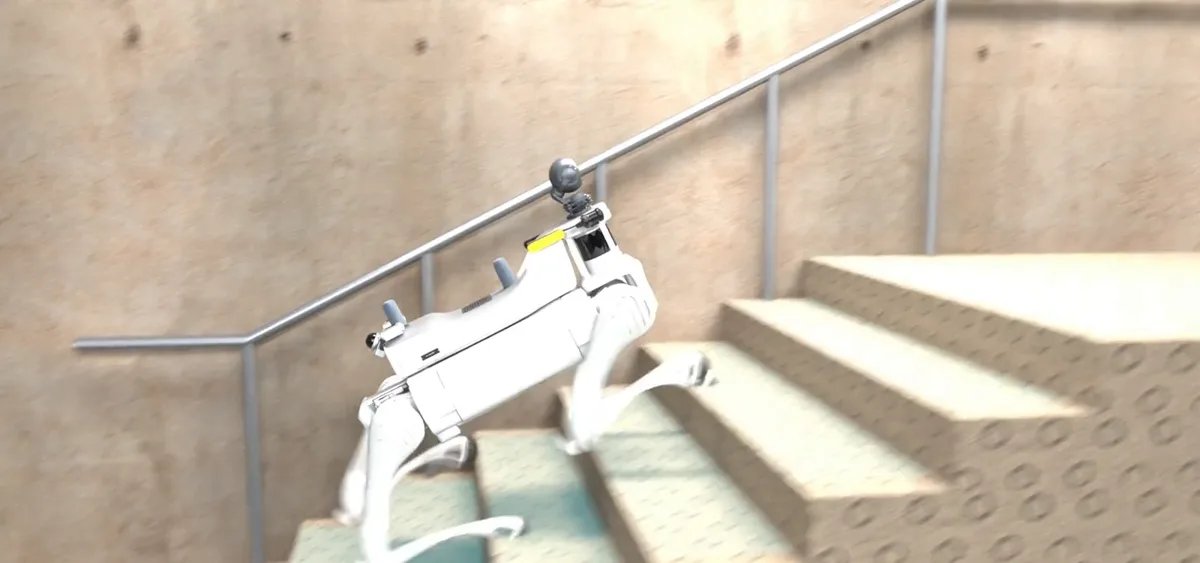
Walk the inspection route and note every place where a wheeled vehicle would stop: stairs, steps at doorways and bulkheads, kerbs, pipes and cable trays across the floor, grating with gaps, narrow passages between equipment, and doors that have to be opened. If there is one stair the robot must climb on every round, the choice is made: a quadruped. A UGV can climb a kerb or a shallow step with tracks, and a ramp can be built for a doorway, but a flight of stairs ends the wheeled option.
If the route is continuous and flat (an outdoor substation yard with paved walkways, a solar plant, a large production hall, a tank farm with roads, a perimeter fence) the UGV is in the running, and usually wins on the other criteria. Most sites have both kinds of route, and a site that needs both a yard patrol and an indoor switchgear round sometimes ends up with one of each.
Terrain, obstacles and recovery
A quadruped handles stairs, steps up to roughly 20 cm, slopes, gravel, pipes and rails on the floor, and gaps in grating. It can turn in place in a passage little wider than its body and crouch under a low pipe. It can also fall: on wet steel, ice or a loose cable it may slip, and current robots stand up on their own but the payload takes the impact. Payload design on a quadruped includes a roll cage or a protected sensor head for this reason.
A wheeled UGV handles paved surfaces, gravel, grass and shallow slopes; a tracked UGV adds mud, snow, kerbs and shallow steps. Neither climbs stairs. UGVs do not fall over on a sensible route, their payload mass can be high and they run for hours, but they stop at the first obstacle across the path that they cannot drive over, and a robot that stops in a doorway blocks it.
Payload mass and mounting
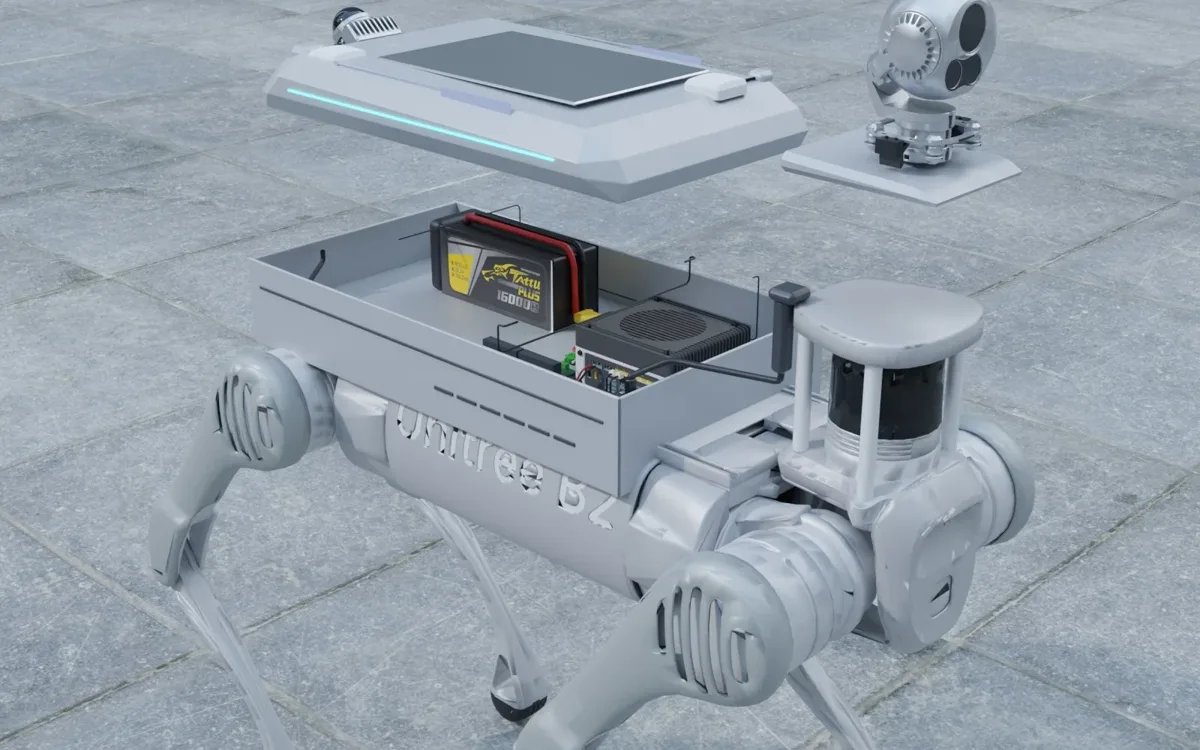
Quadrupeds carry little and want it placed carefully. A Unitree Go2 EDU carries 2 to 3 kg of sensors; a Unitree B2 or DEEP Robotics X30 carries a complete inspection payload of 8 to 12 kg while walking, with the mass low and over the hips so that the gait and stair climbing are unaffected. That rules out tall masts, heavy pan-tilt units and a second battery for long runtime.
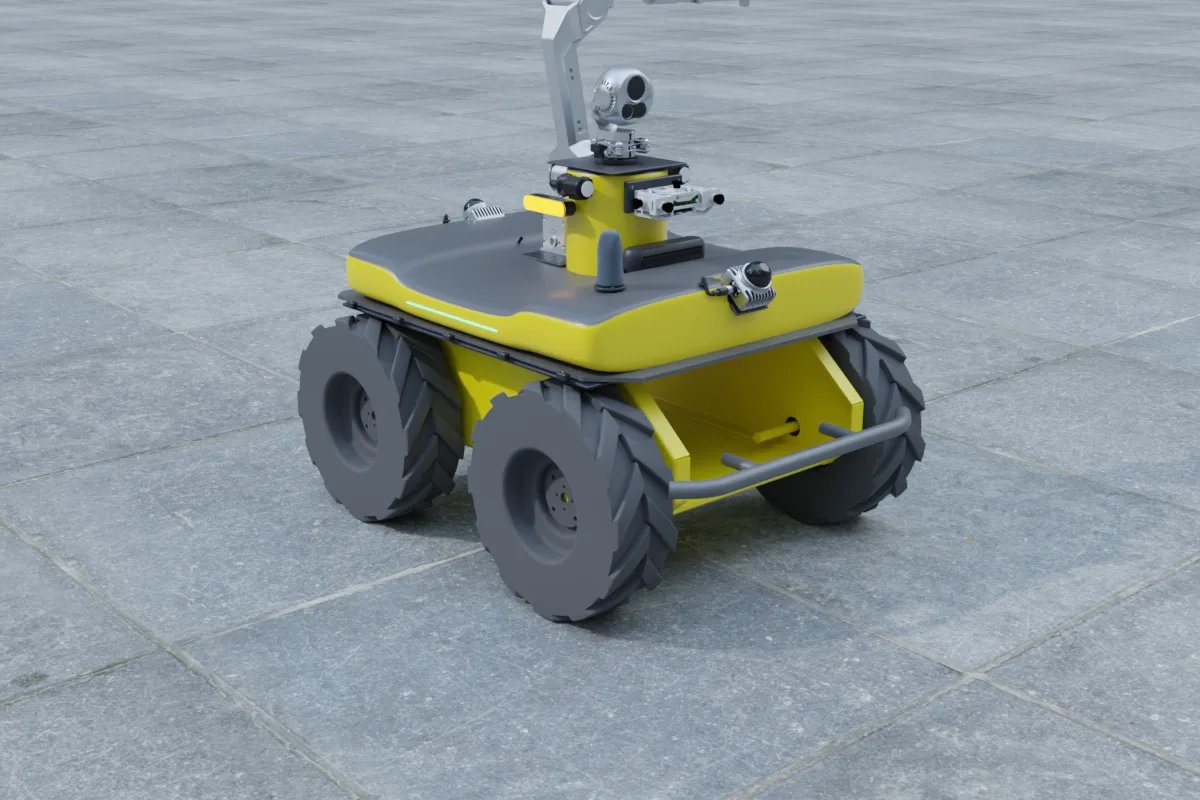
UGVs carry a lot and do not care much where. A Clearpath Husky A200 carries up to 75 kg, an AgileX Hunter 2.0 up to 150 kg, an AgileX Bunker about 70 kg, and small UGVs such as a Scout Mini or Clearpath Jackal 10 to 20 kg. The payload can include a mast that lifts the camera head to 1.5 or 2 m for a view over equipment, a large battery, a robot arm for valve and door operation, or several sensor heads. The mounting is a plate on the deck and the wiring is unconstrained.
Speed and runtime
A quadruped walks at about 1 m/s on an inspection round and faster on open ground; it runs 1.5 to 2 hours with a payload and then returns to a dock or has its battery swapped. A UGV drives at 1 to 2 m/s on an inspection round (its top speed is rarely useful between inspection points) and runs 4 to 8 hours, sometimes longer with a payload battery. Over a day with several rounds the UGV covers far more distance per charging stop. For a perimeter patrol of several kilometres this is the deciding difference; for an indoor round of a few hundred metres it is not.
Weather and protection
Current industrial quadrupeds carry an ingress rating from their makers and work in rain and dust; they are weaker on ice and slick surfaces, where legs lose grip. UGVs are generally more weather-tolerant, run in snow and mud on tracks, and have a lower centre of gravity for wind and slopes. In explosive atmospheres neither standard platform may be used; certified explosion-protected tracked robots exist, certified quadrupeds are rare and expensive.
Cost and upkeep
A quadruped costs more to buy for the payload it carries, and more to keep: twelve leg actuators wear and need service, foot pads are consumables, and a fall can damage the robot or the sensors. A UGV has four or six motors, a steel or aluminium frame and tyres or tracks that last for years; its spare-parts list is short and its service interval long. Where both can run the route, the UGV is the cheaper robot over its life, usually by a clear margin. Where the route needs legs, the quadruped's extra cost is the price of doing the inspection at all.
What changes in the sensor payload
The sensors are the same on both platforms: a radiometric thermal camera with a visible zoom camera on a pan-tilt head, a LiDAR for mapping and localization, a gas block, an acoustic imager or partial-discharge probe where the site needs it, an environmental sensor, lighting, compute and communications. What changes:
- Mass budget: 8 to 12 kg complete on a B2 or X30, 20 kg or more on a UGV, so the UGV payload can carry a heavier head, a mast and a bigger battery.
- Geometry: low and central on the quadruped; on the UGV the head is lifted on a mast for a view over equipment, which matters in yards and tank farms.
- Power: a quadruped payload runs from its own 48 V pack to protect the robot's runtime; a UGV payload usually runs from the vehicle's large battery through a payload power port.
- Navigation: the same LiDAR SLAM software; the quadruped adds stair and step handling from the robot's own controller, the UGV adds RTK GNSS for long outdoor routes.
- Protection: the quadruped payload gets a protected sensor head for falls; the UGV payload gets a taller, heavier weather enclosure.
The inspection software is the same on both: routes and named points, thresholds per point, trending across rounds, graded alarms, reports to the owner's maintenance system. A site that runs one of each uses one operator interface.
Typical choices
- Indoor switchgear rooms, multi-level plants, cable tunnels, metro corridors: quadruped (B2, X30).
- Outdoor substation yards, solar and wind sites, tank farms, perimeters: wheeled UGV (Husky, Hunter) or tracked UGV (Bunker) where the ground is soft.
- Small indoor plants with no stairs, warehouses, data centres: small UGV (Scout Mini, Jackal) or a Go2-class quadruped with a light payload.
- Sites with both a yard and multi-level buildings: one of each, sharing the operator software, or a quadruped alone if the yard round is short.
If you are choosing between a UGV and a robot dog for a site, send us the route (a plan or a walk-through video), what has to be inspected and how often; we will tell you which platform and which payload we would propose, and why.
FAQ
Which is better for industrial inspection, a UGV or a robot dog?
Neither in general. A robot dog wins where the route has stairs, steps, kerbs, pipes or narrow passages, which is most indoor plants, substations with steps and tunnels. A UGV wins on flat, continuous routes outdoors or in large halls, where it carries more, runs longer, costs less and needs less upkeep.
How much payload does each carry?
A Unitree B2 or DEEP Robotics X30 carries a complete inspection payload of 8 to 12 kg while walking; a Unitree Go2 EDU 2 to 3 kg. A Clearpath Husky A200 carries up to 75 kg, an AgileX Hunter 2.0 up to 150 kg, a Bunker about 70 kg, and a small UGV such as a Scout Mini about 10 kg.
How long does each run?
A quadruped with a payload runs 1.5 to 2 hours of inspection and then docks or swaps a battery; a UGV runs 4 to 8 hours and some models much longer. Over a day of rounds the UGV covers more distance with fewer charging stops.
Which costs more to own?
A quadruped costs more to buy per kilogram of payload and has far more moving parts: twelve leg actuators that wear, foot pads that are replaced, and a fall that can damage sensors. A UGV has four motors, a simpler frame and a lower centre of gravity. Where both can do the route, the UGV is cheaper over the robot's life.
Is the sensor payload different?
The sensors are the same: a thermal and visible camera head, LiDAR, gas block, acoustic imager, compute and communications. On a UGV the payload is heavier and larger, usually with a taller mast for the camera head and a bigger battery; on a quadruped it is compact, low and balanced over the hips, and limited to about 12 kg.