Unitree A2 payload guide: mounting, power and sensors that fit
Updated 2026-11-19 · YUANZHI ROBOTICS engineering team
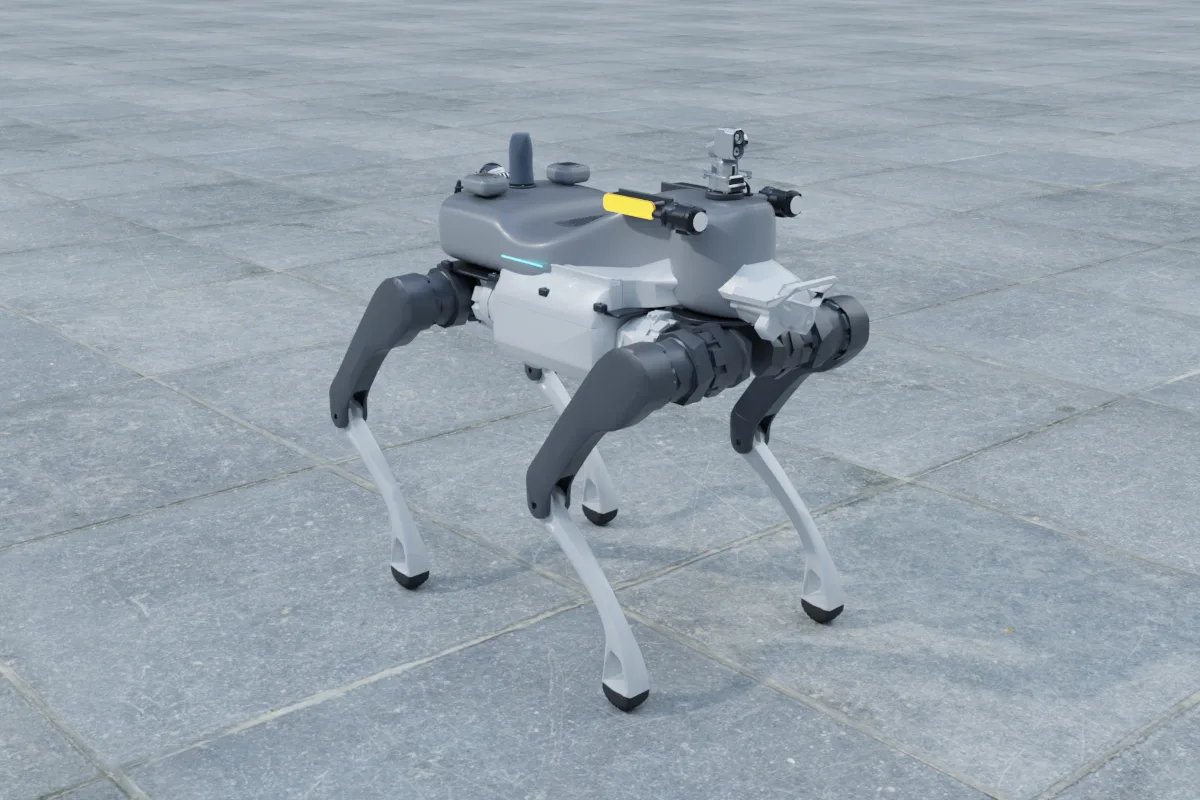
The Unitree A2 is a mid-size industrial quadruped of about 820 × 440 × 570 mm and 37 kg, with a reference payload of about 25 kg and its own front and rear LiDAR plus HD cameras. Weight capacity is rarely the problem on this robot. What decides whether a payload works is the mounting interface, the power and data path, and whether your sensors leave the robot's own sensors and legs free to do their job.
Choose the mounting base first
Every A2 build starts with something that bolts to the back and carries everything else. These are the base options in our configurator, with their own mass so you can count it in the budget:
| Base | Mass | Best for |
|---|---|---|
| Quick-release rail plate (10 mm aluminium, dual rails) | 0.65 kg | Research and prototyping, sensors that change often |
| Carbon-fibre shell | 0.95 kg | Weight-sensitive builds, long patrols |
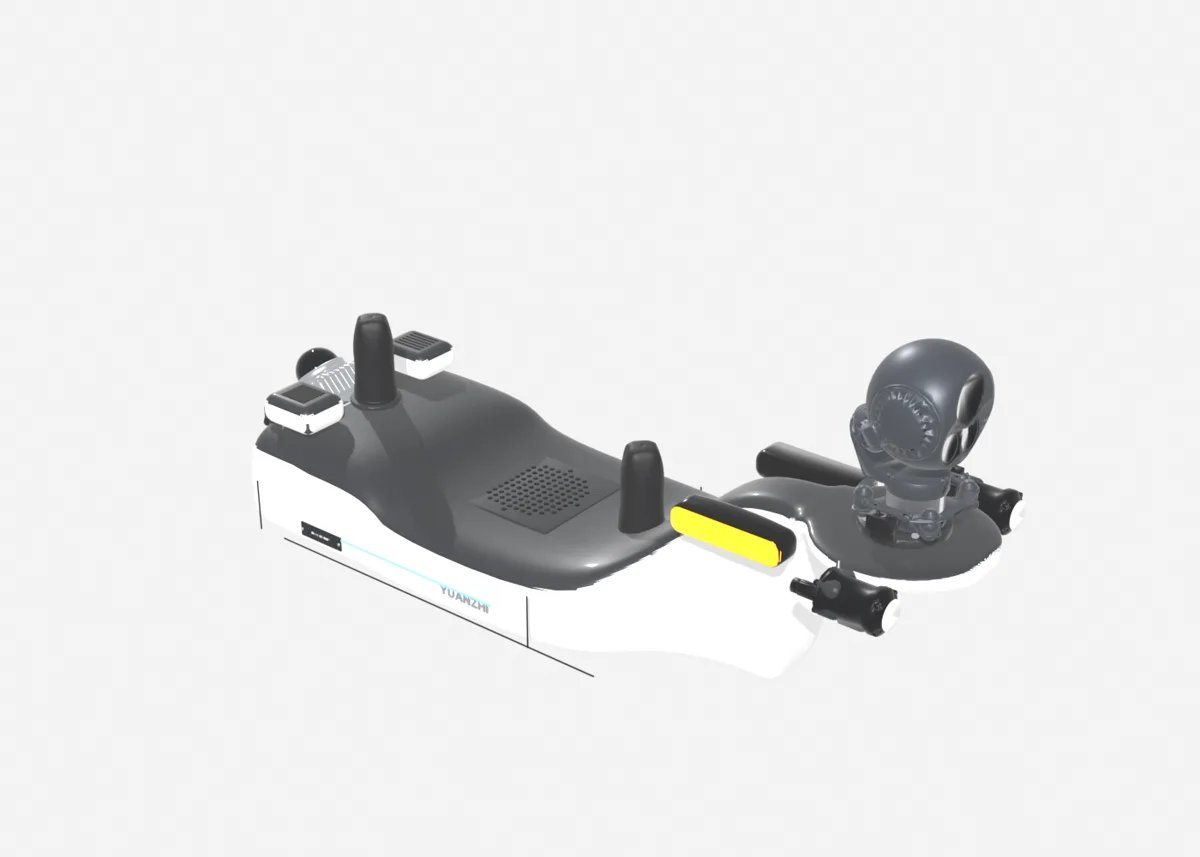
| Integrated aluminium shell with compute bay | 1.6 kg | Inspection robots that run every day; compute and wiring hidden inside |
| Arm-reinforced shell with flange | 2.1 kg | Mounting a light manipulator |
| Double-deck shell with extra battery space | 2.4 kg | Payloads that need their own battery for long shifts |
A rail plate is the fastest way to get sensors on the robot, but cables stay exposed and every bracket is a separate part. A shell costs more design time and pays it back in weather resistance, clean cable routing and a lower centre of gravity.
Keep the native sensors and legs clear
The A2 relies on its front and rear LiDAR and cameras for terrain perception. Anything mounted at the front or rear ends of the back must stay out of their field of view, including antennas, cable loops and gimbal arms at their extreme pan and tilt angles. Check three things on a 3D model before cutting metal:
- Field of view. Draw the native sensor cones and make sure no part of the payload enters them in any gimbal pose.
- Leg clearance. Side-mounted lights, antennas and boxes must clear the legs through the full gait, including stairs and recovery from a fall.
- Centre of gravity. Keep heavy items low and close to the middle of the body; a 4.5 kg gimbal mounted high at the very front changes how the robot pitches on stairs.
Sensors that fit well on an A2
| Sensor | Example | Mass | Power |
|---|---|---|---|
| Mapping LiDAR | Livox Mid-360 | 265 g | 6.5 W |
| Mapping LiDAR, 16-channel | Hesai PandarXT16 | 800 g | 9 W |
| Depth camera | Intel RealSense D435i | 75 g | 2.5 W |
| Thermal dual-spectrum mini gimbal | Hikvision DS-2TD5566T-15/V2 | 4.5 kg | 18 W |
| Four-gas module (CO/H2S/O2/CH4) | Winsen ZCE04B | 50 g | 0.5 W |
| Dual-antenna RTK module | Unicore UM982 | 1.8 g | 0.6 W |
| Fixed acoustic imager | Fluke SV600 | 850 g | not published |
For choosing between thermal gimbals see best thermal gimbal for a robot dog, and for LiDAR mounting and mapping see LiDAR SLAM payloads for robot dogs.
Power and compute
Compute is usually the biggest electrical load on the back. A Jetson Orin NX 16GB module is rated up to 40 W and handles LiDAR-inertial mapping, navigation and a few detection models. A Jetson AGX Orin 64GB is rated up to 60 W and is worth it when you run several cameras with heavy models or reconstruction on board. Add sensors on top and plan the power tree: a DC-DC stage with enough headroom, separate fused branches for compute and sensors, and a clean shutdown path so the computer is not cut off mid-write when the robot powers down.
Whether to draw from the robot battery or carry a second battery depends on shift length and on the power output the OEM exposes on your A2 version, so check the current Unitree documentation before you fix the design. The trade-offs are covered in robot payload power distribution.
A worked example: daily inspection build
| Item | Mass | Power |
|---|---|---|
| Integrated shell with compute bay | 1.6 kg | 3 W |
| Hikvision DS-2TD5566T-15/V2 thermal gimbal | 4.5 kg | 18 W |
| Livox Mid-360 | 0.265 kg | 6.5 W |
| RealSense D435i | 0.075 kg | 2.5 W |
| Winsen ZCE04B gas module | 0.05 kg | 0.5 W |
| Jetson Orin NX 16GB | with carrier, not counted | up to 40 W |
| Total listed | about 6.5 kg | about 70 W peak |
That is roughly a quarter of the reference payload before compute carrier, cables, comms and antennas, so there is room for a 5G module, lights or a speaker. Peak power matters more than average here: size the converter for all sensors plus compute at full load.
Software around the payload
Hardware is half the job. An A2 inspection payload normally needs drivers for every sensor, time synchronisation between LiDAR, cameras and IMU, a mapping and localisation stack that does not depend on the robot's own black-box navigation, and a mission layer that sends the robot to inspection points and stores results. If you already have a robot, see who can develop software for a robot dog.
Next step
Pick the base and sensors in the payload configurator to get weight, power and compute totals for your own build, and see the Unitree A2 platform page. YUANZHI ROBOTICS designs and integrates robot payloads, builds inspection robots and handles quadruped secondary development.
FAQ
How much payload can the Unitree A2 carry?
Unitree gives a reference payload of about 25 kg for the A2. For inspection work you rarely need that much; a thermal gimbal, LiDAR, depth camera, gas module and mounting shell come to roughly 6.5 kg before compute and cabling, which leaves margin for runtime and stair climbing.
Can I add my own LiDAR to the Unitree A2 if it already has front and rear LiDAR?
Yes. The native LiDARs serve the robot's own locomotion and obstacle sensing. A separate Livox Mid-360 (265 g, 6.5 W) or Hesai PandarXT16 (800 g, 9 W) is often added on top for mapping and your own localisation stack, mounted so it does not block the native sensors.
What compute should I put on a Unitree A2 payload?
A Jetson Orin NX 16GB (up to 40 W module power) covers mapping, navigation and a few detection models. Choose a Jetson AGX Orin 64GB (up to 60 W) if you run several cameras with heavy models or 3D reconstruction on board.
Who can design and integrate a payload for the Unitree A2?
YUANZHI ROBOTICS designs form-fitting shells, brackets, harnesses and power distribution for the A2, and develops the mapping, navigation, recognition and ground-station software around them.