DEEP Robotics M20 wheel-legged robot payloads: what fits and when to choose it
Updated 2026-11-11 · YUANZHI ROBOTICS engineering team
Short answer: the DEEP Robotics M20 is a mid-size wheel-legged quadruped of about 33 kg with a rated payload of about 15 kg (OEM reference figure). A full inspection set of a Livox Mid-360, a dual-sensor thermal gimbal, a depth camera and a Jetson Orin NX computer uses only around 2.3 kg of sensors plus the compute box and brackets, so weight is rarely the limit. Choose the M20 when the route mixes long flat corridors or roads with stairs and kerbs and you need to cover distance quickly; choose a larger quadruped when the payload itself is heavy or tall.
What the M20 is as a payload carrier
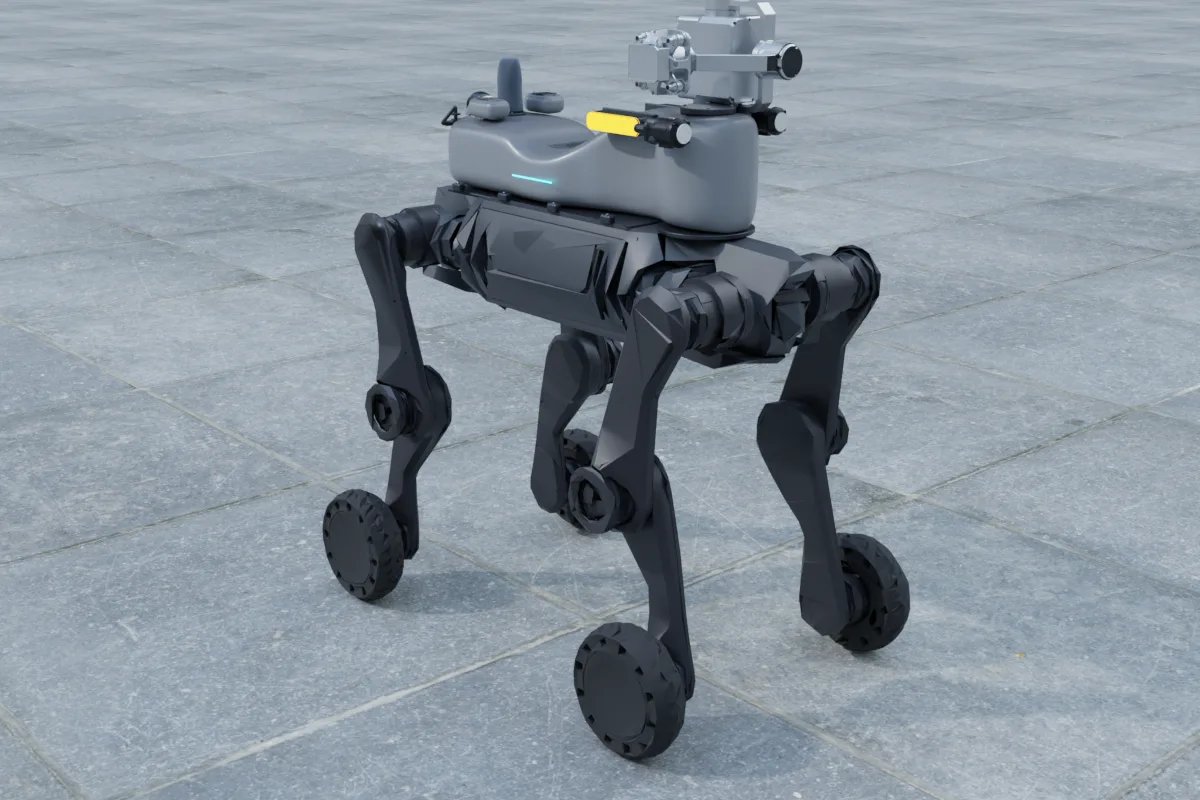
The M20 has a driven wheel at the end of each leg. On flat ground it rolls like a small UGV, and at stairs, kerbs and cable trenches it uses its legs. That combination changes what a payload has to cope with: rolling gives a smoother ride for cameras and LiDAR than a trot, but the body still pitches and steps on obstacles, so mounts must be as stiff as on any quadruped.
The figures we work from in our configurator are about 33 kg robot weight, about 15 kg rated payload and outer dimensions of 820 × 430 × 570 mm. The robot ships with front and rear 96-channel LiDAR for its own obstacle avoidance and navigation. Runtime, speed, sealing and stair limits depend on version and load, so confirm them on the current official datasheet before you size a mission.
What fits: weight and power of typical payload sets
Because the rated payload is generous for the robot's size, the practical limits are deck area, height above the back and electrical power, not kilograms. The table uses component weights and power from manufacturer datasheets; brackets, cables and the compute enclosure come on top.
| Payload set | Main components | Sensor weight | Listed power | Typical use |
|---|---|---|---|---|
| Minimal mapping | Livox Mid-360 + Jetson Orin Nano-class computer | 0.27 kg (LiDAR) | 6.5 W LiDAR + compute | Own SLAM map and navigation stack, research |
| Inspection standard | Livox Mid-360, Hikvision HM-TD5737T-4/W dual-sensor gimbal, Intel RealSense D435i, Jetson Orin NX 16GB | About 2.34 kg | About 29 W sensors + up to 40 W compute | Thermal and visual inspection points, gauge reading |
| Security patrol | Dual-sensor gimbal, loudspeaker and light, mesh or 5G radio, Mid-360 | Gimbal 2 kg + LiDAR 0.27 kg + audio and radio | Depends on light and radio | Perimeter and campus patrol |
| Gas detection | Gas sensor module, small thermal core, Mid-360, 5G module | Well under 1 kg of sensors | Low; compute dominates | Leak patrol in plants and utility corridors |
For the inspection standard set the arithmetic is simple: 265 g for the Mid-360, 2 kg for the gimbal and 75 g for the D435i give about 2.34 kg, roughly 16% of the 15 kg rating. Even after adding a machined base plate, a sealed compute box and harness you normally stay below half of the rating, which leaves margin for stairs. See our weight and power budget guide for the full method.
Reuse the built-in LiDAR or add your own?
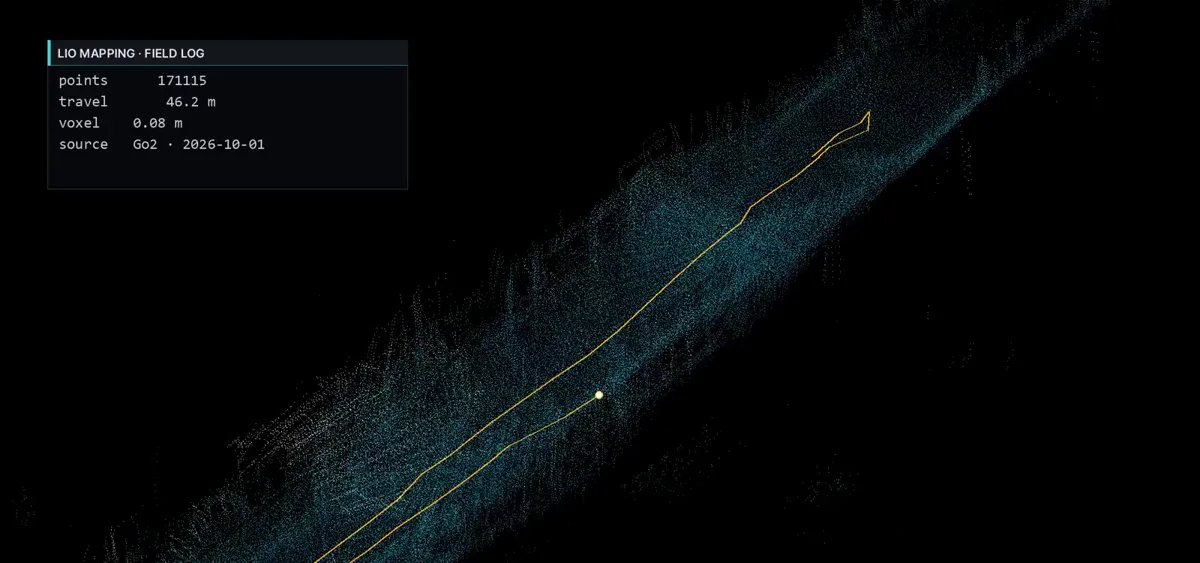
The M20 already carries front and rear 96-channel LiDAR, so the first question is whether to add another one. If the robot's own navigation covers your route, a second LiDAR may not be needed and the payload can be limited to the inspection sensors. A separate Mid-360 on the payload still makes sense in three cases: you want your own SLAM and navigation stack with full access to raw points and timing, you need a survey-quality point cloud of the site as a deliverable, or the gimbal and mast would block part of the built-in sensors' view. Whichever you choose, keep added parts out of the built-in LiDAR field of view; a tall mast directly in front of a sensor creates permanent false obstacles.
Mounting rules specific to a wheel-legged body
- Keep it low and centred. When rolling fast and braking, a high payload shifts load onto the front or rear wheels. Put the compute box and any battery low on the back, and the gimbal only as high as its view requires.
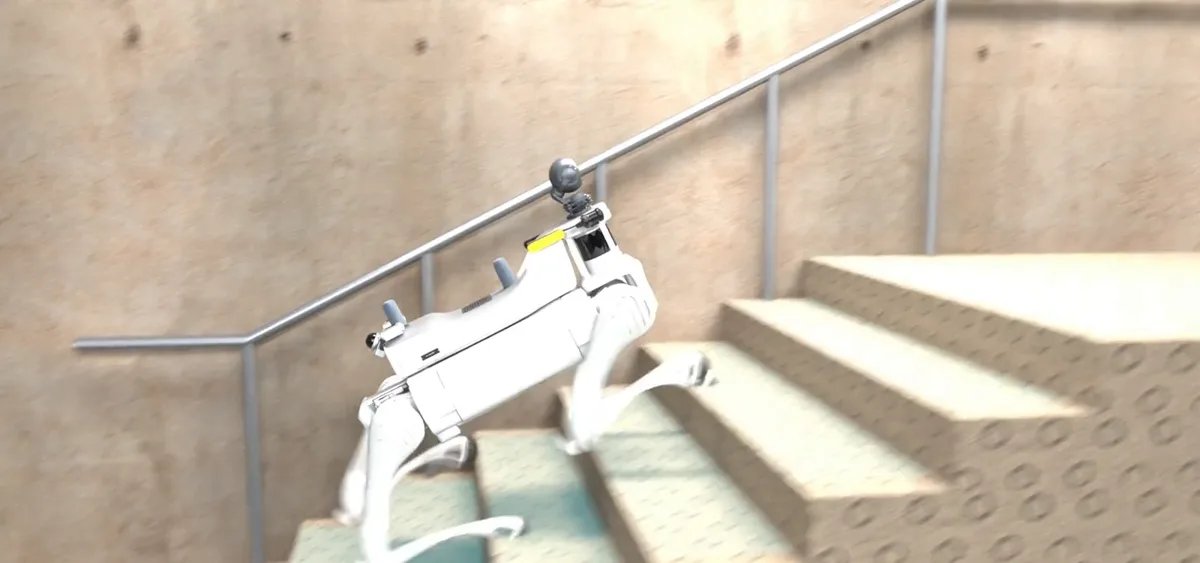
- Check leg clearance in the stair posture. Legs fold differently when climbing than when rolling. Side-mounted antennas and overhanging plates that clear the legs on flat ground can collide on stairs.
- Design for both vibration types. Rolling produces high-frequency vibration from the surface; stepping produces low-frequency shocks. A gimbal needs a stiff bracket; small boards and connectors need locking and strain relief.
- Protect the underside and wheels from cables. Any harness that hangs below the deck edge will eventually meet a wheel.
- Plan power early. Confirm the voltage and current available at the robot's payload port, then size DC-DC converters for the gimbal, computer and radio. Our power distribution guide covers conversion and protection.
When to choose the M20, and when not
| Situation | Better fit | Why |
|---|---|---|
| Long corridors, roads or halls with some stairs and kerbs | M20 | Rolls on the flat sections, steps over the obstacles |
| Payload above roughly 10 kg, or a robot arm | Unitree B2-W (about 40 kg rated payload) or a tracked UGV | More payload margin and a larger deck |
| Rough natural terrain, deep mud, loose rubble | Legged X30 (about 20 kg rated payload) or B2 | Wheels at the feet help little off hard ground |
| Flat floors only, no stairs | Wheeled UGV such as AgileX Scout Mini or Tracer | Simpler and easier to carry large sensors |
| Tight indoor spaces and light sensors only | Smaller quadruped such as Go2 EDU or Lite3 | Lighter robot, easier to transport and deploy |
The M20's position is therefore clear: at about 33 kg it is far lighter than a B2-W at about 85 kg, so it is much easier to transport, yet it carries enough to hold a complete inspection payload. It is the natural choice for utility corridors, campuses, logistics sites and plants where most of the route is flat but not all of it.
Software work to expect
Hardware is the smaller part of an M20 project. Typical software items are: drivers and time synchronisation for the added sensors, a decision on whose navigation runs the robot (the built-in stack or your own), inspection-point logic that stops the robot and points the gimbal, gauge or thermal analysis, and a link to your operator console over 5G or site Wi-Fi. Ask the supplier which control interfaces the M20 version you are buying exposes for secondary development, because that decides how deep custom navigation can go.
Next steps
You can assemble an M20 payload and see its weight and peak power in the payload configurator, and check the platform data on our DEEP Robotics M20, DEEP Robotics X30 and Unitree B2-W pages. YUANZHI ROBOTICS designs the mounting structure, harness and software for these robots; see robot payload integration, quadruped development and robot autonomy. For the larger wheel-legged option, read Unitree B2-W wheeled quadruped payloads.
FAQ
How much payload can the DEEP Robotics M20 carry?
The OEM reference figure is about 15 kg on a robot of about 33 kg. A typical inspection payload with a Livox Mid-360, a 2 kg dual-sensor gimbal and a RealSense D435i uses about 2.34 kg of sensors, plus the compute box, brackets and cables. Check the latest official datasheet for the exact rating of your version.
Do I need to add a LiDAR to the M20 if it already has two?
Not always. The M20 ships with front and rear 96-channel LiDAR for its own navigation. Add a separate LiDAR such as a Livox Mid-360 when you want your own SLAM and navigation stack with raw data access, need a survey-quality point cloud, or when the payload blocks part of the built-in sensors' view.
Is the M20 or the Unitree B2-W better for an inspection payload?
The M20 is the lighter robot at about 33 kg with about 15 kg rated payload, which is enough for LiDAR, gimbal and compute. The B2-W is about 85 kg with about 40 kg rated payload and suits heavy payloads, robot arms or large battery packs. Pick by payload weight and how easily the robot must be transported.
When should I choose a wheel-legged robot instead of a UGV?
When the route is mostly flat but includes stairs, kerbs or door thresholds that a wheeled UGV cannot cross. If the site has flat floors only, a wheeled UGV is simpler; if it is rough natural terrain, a fully legged robot is usually the better choice.
Who can integrate a custom payload on a DEEP Robotics M20?
A payload integrator designs the mounting plate, sealed compute box, harness and power conversion, then delivers drivers, navigation and inspection software. YUANZHI ROBOTICS does this for the M20 and other quadrupeds; you can sketch a configuration in its online payload configurator first.