Thermal camera vs optical gas imaging on a robot dog: what each can and cannot detect
Updated 2026-11-16 · YUANZHI ROBOTICS engineering team
A standard thermal camera and an optical gas imaging (OGI) camera both work in the infrared, but they answer different questions. A thermal camera tells you how hot a surface is, so it finds overheating joints, bearings and motors. An OGI camera is filtered to the narrow band where a particular gas absorbs infrared, so it makes a leak visible as a moving plume. A thermal camera will not reliably show a gas leak, and an OGI camera is not the right tool for measuring equipment temperature. This guide explains the difference and how we decide what goes on a robot dog.
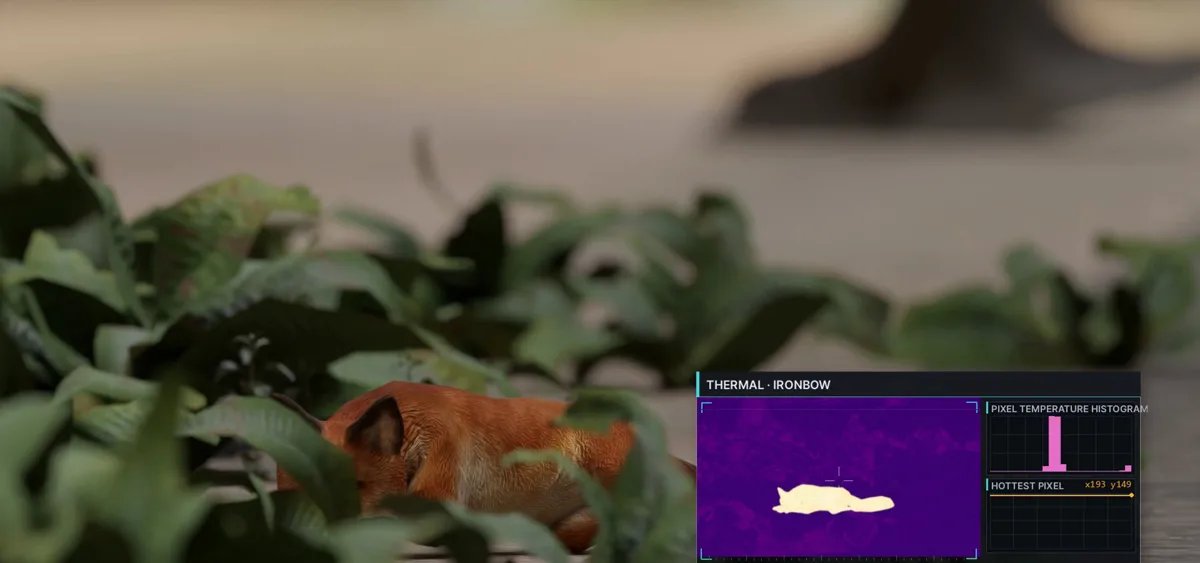
What a standard thermal camera actually measures
Most thermal cameras used on robots are uncooled microbolometers working across the long-wave band, roughly 8 to 14 micrometres. They integrate energy over that whole band and convert it to a temperature for each pixel. That is exactly what you want for electrical and mechanical inspection: a loose busbar joint, a failing bearing or a blocked cooler shows up as a temperature difference against its neighbours, and a radiometric core lets the software store a number for each inspection point and compare it over time.
Most gases are almost transparent across that wide band, or absorb only in a narrow slice of it. Averaged over the whole band, a thin plume barely changes the reading, so on a normal thermal image the leak is invisible. Sometimes you see side effects, such as frost where expanding gas cools a fitting, but you cannot rely on that for leak detection.
What optical gas imaging adds
An OGI camera puts a narrow band-pass filter in front of the detector, matched to an absorption band of the target gas. Gas in the field of view now absorbs or emits a noticeable share of the energy the camera sees, so it appears as a dark or light cloud against the background. Two families matter in practice:
- Cooled mid-wave OGI, filtered around the hydrocarbon absorption band near 3.3 micrometres, for methane, propane, other light hydrocarbons and many VOCs. These use a cooled detector, which brings extra weight, power, cooler run-up time and cost.
- Long-wave OGI, filtered for gases that absorb in the long-wave band, such as SF6, ammonia and some refrigerants. These are used in substations and refrigeration plants.
One OGI camera does not see every gas. The camera is chosen for the gas list of the site, which is why we ask for that list before anything else.
Side-by-side comparison
| Question | Standard thermal camera | Optical gas imaging camera |
|---|---|---|
| Primary job | Surface temperature, hot-spot detection | Visualising leaks of specific gases |
| Typical band | Broadband long-wave, about 8-14 µm | Narrow band matched to the gas (mid-wave for hydrocarbons, long-wave for SF6 and others) |
| Sees methane leaks | No (only indirect clues) | Yes, with a hydrocarbon-filtered camera |
| Sees SF6 leaks | No | Yes, with an SF6-capable long-wave camera |
| Gives a number | Temperature per pixel (radiometric cores) | Qualitative image; concentration needs extra quantification |
| Detector | Uncooled, starts instantly | Often cooled (mid-wave), needs run-up time |
| Size on a robot | From a few grams for a bare core to about 2 kg for a dual-spectrum pan-tilt unit | Usually a larger, heavier camera; check the vendor datasheet against the robot payload limit |
Real numbers for the thermal side
Thermal options span a wide range on the same robot, and the choice is mostly about resolution, optics and whether you need pan-tilt. From the components we integrate:
- Micro modules such as the InfiRay Tiny1-C (256×192, about 3.9 g, 0.24 W) or GST TIMO256 (256×192, about 2.2 g) suit fixed close-range checks such as a cabinet scan.
- Teledyne FLIR Boson 640 (about 7.5 g, 0.5 W) and GST PLUG417 (384×288, about 85 g, 2 W) are cores we build into a custom head with our own lens and window.
- Dual-spectrum pan-tilt units such as the Hikvision HM-TD5737T (about 2 kg, 20 W) combine thermal with a zoom visible camera; larger units such as the DS-2TD5566T (640×512 thermal plus 1080p visible) reach about 4.5 kg and 18 W, which only the heavier quadrupeds carry comfortably.
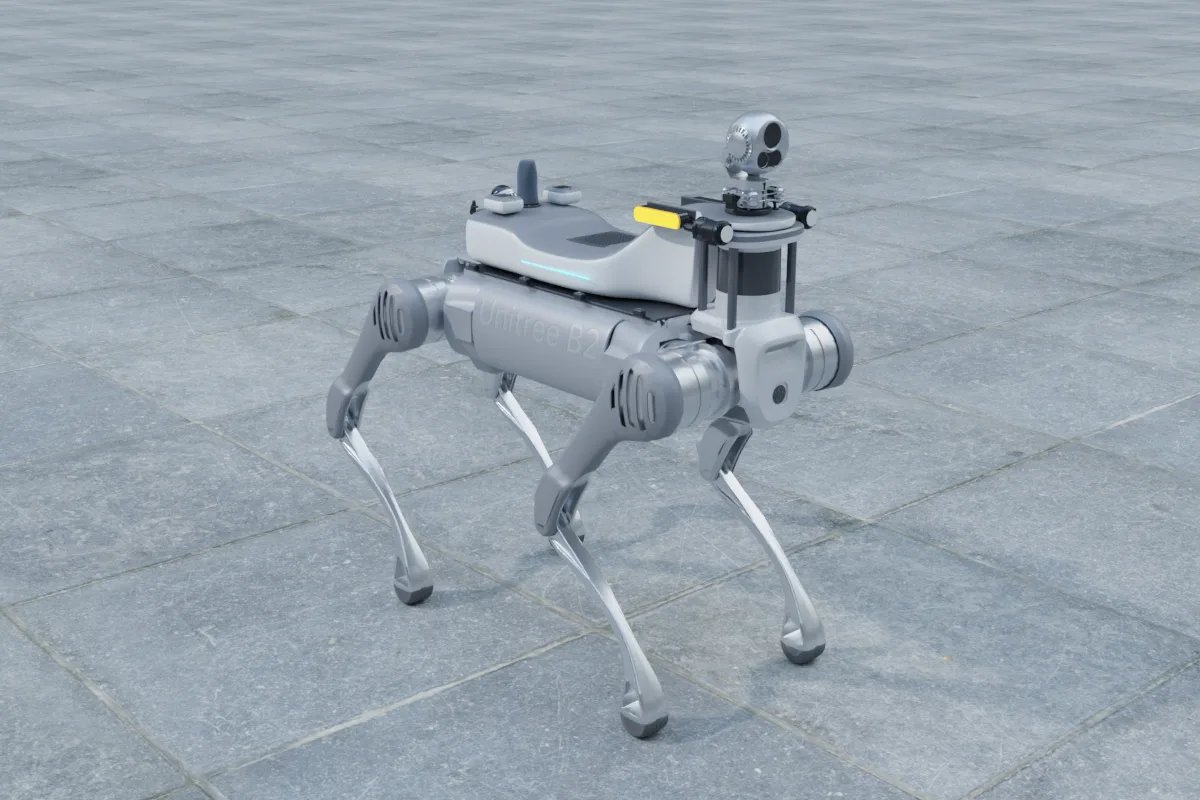
An OGI camera has to be added on top of this budget. On a Unitree Go2 class robot that is rarely realistic; on a Unitree B2 or DEEP Robotics X30 it can be, after the weight and power budget is checked. Our payload weight budget guide shows how we do that.
Things that make OGI hard on a moving robot
- Temperature contrast. The plume is visible only if the gas and the background differ in temperature. A leak against a sky or a wall at the same temperature can disappear, so viewpoints are planned, not left to chance.
- Motion. Plumes are easiest to see as movement. A walking robot shakes the image, so the robot stops at each inspection point and records a short steady clip.
- Wind and distance. Wind disperses small leaks quickly; stand-off distance has to be chosen per point.
- Interpretation. OGI output is an image, not an alarm value. Turning it into an alarm needs detection software, which is a separate development task.
The combination we usually recommend
For substations and power plants the common set is a dual-spectrum thermal and zoom camera for equipment temperature and gauge reading, plus point sensors for the gas list, for example an NDIR SF6 module such as the Cubic SF6-015 (about 0.65 W) with electrochemical O2, CO and H2S cells. Point sensors give a concentration and an alarm threshold; they do not show where the leak is. Our gas detection payload guide covers sampling and calibration, and the substation payload guide shows the full set for that site type.
For oil, gas and chemical sites where locating hydrocarbon leaks is the main task, we add either a laser methane detector, which measures along a beam at a distance, or an OGI camera on a heavier robot, and keep the thermal camera for rotating equipment. Using point sensors to confirm what the image shows is more robust than relying on either alone.

Next step
Send us your gas list, the equipment you need to measure and your robot model, and we will propose a thermal, gas and camera set that fits its payload limit. You can start in the payload configurator, look at the Unitree B2 or DEEP Robotics X30 platform pages, or read about our inspection robot and robot payload services.
FAQ
Can a normal thermal camera on a robot dog detect gas leaks?
Generally no. A broadband 8-14 micrometre thermal camera shows surface temperature. It may hint at a leak indirectly, for example frost on a valve from expanding gas, but it does not image the gas itself. Seeing the gas needs an optical gas imaging camera filtered for that gas, or a point or laser gas sensor.
Which gases can optical gas imaging see?
It depends on the filter. Cooled mid-wave OGI cameras are built for hydrocarbons such as methane, propane and VOCs. Long-wave OGI variants target gases such as SF6, ammonia and some refrigerants. One camera does not cover all gases, so the camera is chosen for the gas list of the site.
Does optical gas imaging tell you the concentration?
Not by itself. OGI shows where gas is and how the plume moves. Concentration or leak rate needs a quantification method with known distance, temperature contrast and wind, or a separate sensor such as a laser methane detector or a sampled point sensor.
Should I put both a thermal camera and gas sensors on one robot dog?
For most electrical and plant patrols, yes: a dual-spectrum thermal and zoom camera for equipment temperature, plus point gas sensors for the site gas list. Add an OGI camera only where finding hydrocarbon or SF6 leak sources visually is a core requirement, because it adds weight and cost.