Robot dog payload for substation inspection: thermal, gauge reading, partial discharge and SF6
Updated 2026-10-30 · YUANZHI ROBOTICS engineering team
Substation inspection rounds repeat the same four checks: is anything hotter than it should be, what do the gauges and indicators say, is anything discharging, and is any gas leaking. A robot dog payload built for substations therefore carries four sensing groups, a computer that runs them, and the mounting and power that keep them working outdoors. This guide explains each group, what it actually measures, where it goes on the robot and what changes between a Go2-class and a B2-class quadruped.
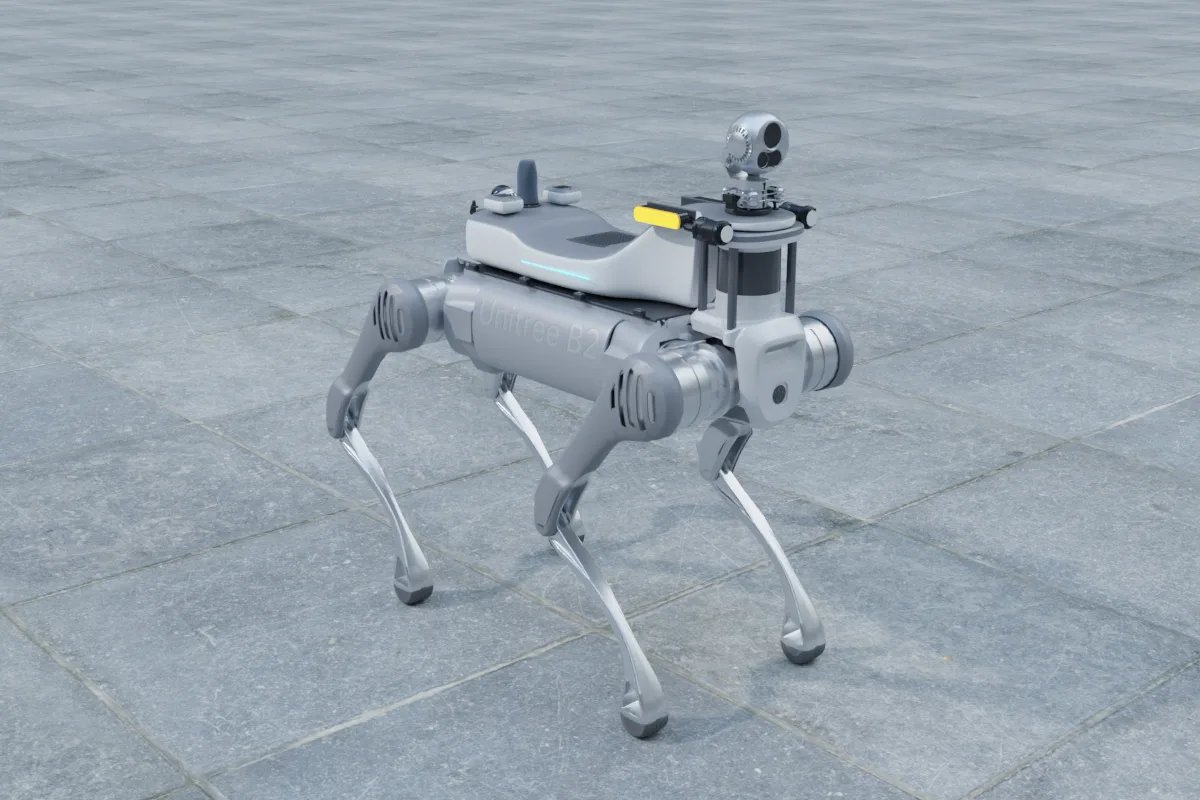
1. Thermal: temperature rise on joints, bushings and connections
The thermal camera is the sensor that finds most faults in practice. Loose connections, overloaded clamps, bushing problems and failing surge arresters all show up as a temperature difference against a reference, either the same phase on a neighbouring unit or the ambient. The payload therefore needs a radiometric core, one that returns a temperature value per pixel, not a video-only module that only produces a pretty image.
- Resolution: 640 x 512 cores resolve small clamps at 5 to 10 m; 384 x 288 and 256 x 192 cores are lighter and cheaper and are fine for close-range indoor switchgear.
- Lens: a 9 to 13 mm lens on a 12 um 640 core gives a field of view that covers a bay from the walkway; longer lenses are used for busbars and overhead connections.
- Range: standard cores cover roughly -20 to 550 C, which is enough for every substation case; higher ranges are a power-plant requirement, not a substation one.
- Output: a USB or GigE radiometric stream that the onboard computer reads directly. The software records the maximum point, the average over a region and the difference to the reference, and raises an alarm on absolute temperature or on temperature rise.
Mount the thermal core next to the zoom camera on the same pan-tilt head so that the two images are registered and an operator can see the visible-light context of every hot spot.
2. Visible: gauges, indicator lamps, disconnector and breaker positions
Reading an SF6 pressure gauge, an oil-level sight glass or the position of a disconnector needs optical zoom, not a wide-angle camera. A 10x optical zoom module on a two-axis head is the usual choice; 30x is used where gauges sit high on bushings or across a fence.
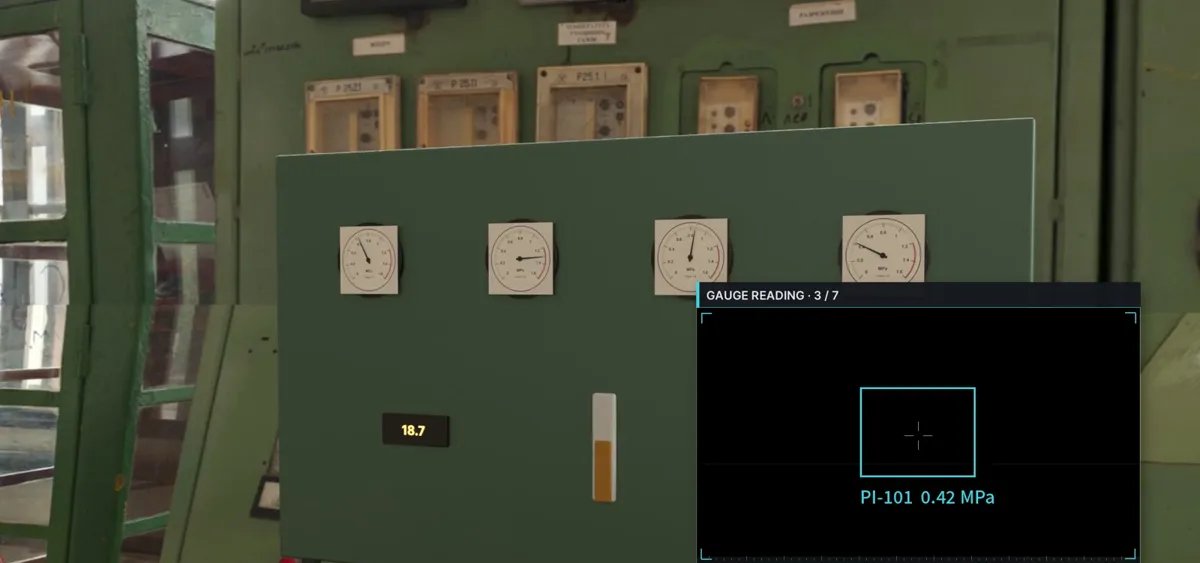
The workflow is deterministic rather than clever: every gauge is an inspection point with a stored robot pose and head angle. The robot stops, the head moves to the stored angle, the camera focuses and captures, and a recognition model reads the pointer or the digits. The value is compared with the limit for that asset and stored with the image. Indicator lamps and breaker position flags are handled the same way with a classification model. Lighting matters more than resolution: an LED or infrared illuminator on the head avoids reflections on glass gauge covers at night.
3. Partial discharge: acoustic imaging versus TEV/UHF
Partial discharge (PD) is the early warning for insulation failure, and substations contain two very different cases.
- Open-air equipment (insulators, bushings, terminations, cable ends): surface and corona discharges emit ultrasound. An acoustic imaging array of 64 to 128 microphones localizes the source and overlays it on a camera image, so the operator sees which insulator is discharging. The same array finds compressed-air and SF6 leaks, which hiss in the same band.
- Metal-clad switchgear and GIS: the discharge is inside a grounded enclosure and is almost inaudible outside. Here TEV (transient earth voltage) sensors on the enclosure and UHF sensors at seams and inspection windows are the standard methods. A robot carries them on a short probe and holds them against or close to the panel at each inspection point.
Many operators fit both, because an acoustic imager alone misses enclosed discharges and a TEV/UHF probe alone misses outdoor insulators. The software side records the level in dB or pC-equivalent per point and trends it over time; a rising trend at the same point is more useful than any single reading.
4. Gas: SF6 first, then the rest
SF6 leaks matter for both safety and equipment life, and infrared (NDIR) SF6 modules are small enough to fit any payload. The module samples the air around the robot, so the sensing distance is short; the robot therefore stops near GIS flanges, density monitors and breaker bodies rather than reading from the walkway. A small sampling pump with an intake tube on the front of the payload shortens the response time.

Beyond SF6, substations with battery rooms, cable basements and control buildings add oxygen, CO and H2S for confined spaces, and sometimes ozone near HV equipment. All of these are electrochemical modules of a few grams; the integration cost is in the sampling path and the calibration schedule, not the sensors.
5. Everything else the payload needs
- Environment: temperature, humidity and noise, mainly so that thermal readings can be normalized and so that noise limits at the fence can be logged.
- Navigation: a 3D LiDAR such as a Livox Mid-360 for mapping and obstacle avoidance, and dual-antenna RTK for outdoor switchyards where the map is large and features repeat; see our RTK guide.
- Compute: a Jetson Orin NX-class module runs the recognition models, the thermal analysis and the mission logic on the robot, so the round completes even when the site network is poor.
- Communication: 4G/5G or site Wi-Fi for live video and alarms; the mission itself does not depend on the link.
- Power: a payload battery with its own BMS, isolated from the locomotion battery.
- Structure: a shell that keeps the thermal and zoom optics clean and dry, with the head high enough to see over cable trays and the LiDAR clear of the head's field of view.
Go2-class or B2-class: what fits
A Unitree Go2 EDU carries roughly 5 kg of payload comfortably, which covers a thermal core, a 10x zoom camera on a light two-axis head, an SF6 module, a Mid-360 and a Jetson. It is a good indoor switchgear and small-substation platform. The acoustic imaging array, a larger thermal core or a dual-spectrum gimbal push the mass and the height of the payload beyond what a Go2 handles well on gravel and kerbs.
A Unitree B2 or similar takes the full set, including the acoustic imager, a dual-spectrum gimbal and a second battery, and its stride handles outdoor switchyard surfaces, drainage channels and ramps. For a comparison of the two platforms as inspection carriers see Go2 EDU vs B2 for inspection payloads.
What the software does with it
The sensors only pay off when every reading is tied to an asset. The inspection software keeps a list of points, each with a robot pose, head angle, the sensors to trigger and the limits to apply. After each round it produces a report with images, values and exceptions, pushes alarms by the operator's preferred channel and keeps the history so that trends, not just single readings, drive maintenance. All of this runs on the robot's computer and syncs to an on-premise server, which is how most utilities prefer it.
Getting it built
You can assemble a substation configuration on your platform in our payload configurator, which sums weight and power per component. Platform notes are on the Unitree Go2 EDU and Unitree B2 pages, and the substation inspection scene page lists the typical component set. YUANZHI ROBOTICS designs and integrates the complete payload, see robot payload integration, and delivers the inspection software with source code, see robot autonomy development.
FAQ
What sensors does a robot dog need for substation inspection?
At minimum a radiometric thermal camera for temperature-rise checks and a zoom camera for reading gauges and switch positions. Partial-discharge sensing (acoustic imaging or TEV/UHF) and an SF6 leak sensor are the next additions, followed by environmental sensors such as temperature, humidity and noise.
Can a robot dog detect partial discharge?
Yes. Two approaches are used: an acoustic imaging array that localizes the ultrasonic emission of surface and air-gap discharges in open equipment, and TEV/UHF sensors for discharges inside metal-clad switchgear and GIS. Many operators fit both because they cover different equipment.
How does the robot read analogue gauges?
A zoom camera on a pan-tilt head is driven to a stored pose for each gauge, takes an image, and a recognition model reads the pointer angle or digits. Readings are compared with limits and stored against the asset.
Which robot dog is better for a substation, Go2 or B2?
A Go2 EDU carries a thermal camera, zoom camera and one or two gas sensors. A B2 has the payload margin for the full set, including an acoustic imager, a larger thermal core and a dual-spectrum gimbal, and handles outdoor switchyards with gravel and kerbs more comfortably.
Does the payload need its own battery?
We recommend it. A separate payload battery keeps sensor power independent of the locomotion battery, avoids voltage dips affecting the cameras and lets the payload stay powered while the robot swaps its own battery.