Gas detection payload for robot dogs: sensors, sampling and alarms
Updated 2026-10-30 · YUANZHI ROBOTICS engineering team
A gas detection payload is one of the simplest things to add to a robot dog or UGV and one of the easiest to get subtly wrong. The sensor modules are small and inexpensive; the engineering is in choosing the right sensing principle for each gas, getting the air to the sensors quickly, keeping them calibrated and turning readings into alarms that mean something. This guide walks through the choices we make when we build one.

Match the sensing principle to the gas
There is no universal gas sensor. Each gas is measured by the principle that suits it, and a payload is a collection of modules.
- Infrared (NDIR): SF6, CO2, and methane at percent level. Stable, no consumable cell, not poisoned by other gases. The SF6 modules used in substations are NDIR.
- Electrochemical: O2, CO, H2S, NH3, Cl2, SO2, NO2, and ppm-level H2. Small, sensitive, cheap; the cell ages and drifts, so calibration matters.
- Catalytic bead: combustible gases (methane, hydrogen, LPG) as percent of the lower explosive limit. Needs oxygen to work and can be poisoned by silicones.
- Photo-ionization (PID): volatile organic compounds as a group, from sub-ppm. Used around fuel, solvents and oil.
- Laser absorption (TDLAS): methane along a beam, over tens of metres. The only principle that detects at a distance; used for gas pipelines and hydrogen or gas storage areas.
- Laser scattering: dust, as PM2.5/PM10 concentration, for coal handling and cement.
For a substation the set is SF6 plus O2, CO and H2S for confined spaces. For a power plant it grows to hydrogen (generator cooling), ammonia (SCR denitrification), SO2 and NO2 (flue gas), CO2 (fire suppression), chlorine (water treatment) and VOCs (fuel oil). For petrochemical sites the combustible and VOC modules dominate. The payload design is the same in every case; only the module list changes.
Sampling: pumped, not diffusion
Most small modules are diffusion sensors: they read whatever air reaches the sensor face. On a moving robot that means slow response and readings that depend on which way the wind blows. We put all the modules in one sampling chamber fed by a micro pump with an intake at the front of the payload, for three reasons:
- response time drops from tens of seconds to a few seconds, so the robot can stop briefly at each point;
- the intake can be a short tube that the robot or a telescopic probe pushes close to a flange, valve stem or cable duct;
- every sensor sees the same air, so readings from different gases at the same moment can be compared.
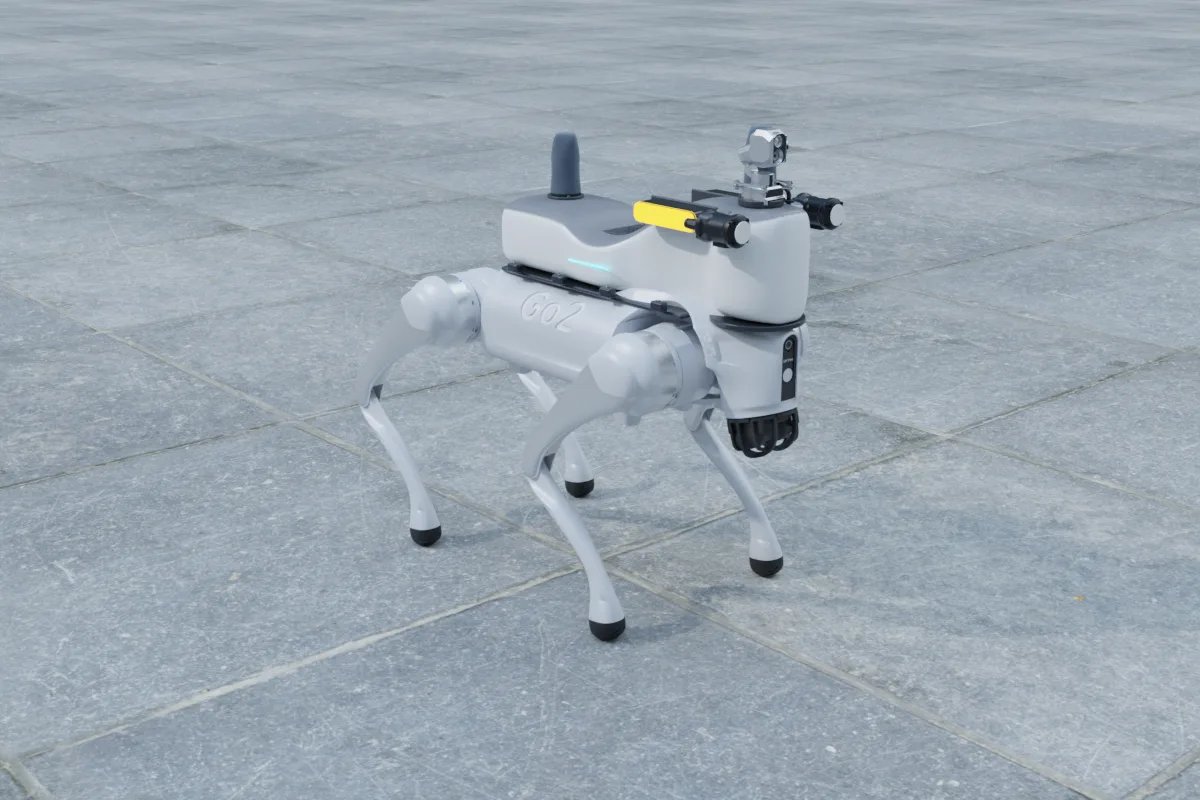
The chamber needs a particulate and water filter on the intake, a flow sensor so the software knows the pump is actually moving air, and an exhaust well away from the intake. On a quadruped the intake sits low at the front, below the camera head, because most leaks (SF6, LPG, most VOCs) are heavier than air; a second intake at the top of the mast is used for hydrogen and methane, which rise.
Calibration and bump testing
Electrochemical cells and catalytic beads drift, and a payload that cannot be calibrated becomes decorative within months. The practical rules:
- mount the modules on a single removable block with one connector, so the block can be taken to the calibration bench or swapped;
- run a bump test (a short exposure to test gas) before rounds that matter, and log the result;
- do span calibration at the interval the module manufacturer specifies, typically between one and six months;
- record zero readings at the start of every round in clean air and flag a module whose zero drifts.
The software stores the calibration date and the last bump-test result for each module and refuses to mark a reading as valid if either is out of date.
From readings to alarms
A concentration by itself is not useful; a concentration at a location, compared with the threshold for that location, is. The inspection software therefore attaches each reading to the inspection point where it was taken, with the robot pose, the time and the pump flow, and applies the limit set for that point: an SF6 reading that is normal at a flange may be an alarm in a control room. Alarms are graded, pushed by whatever channel the operator uses, and the readings are trended over time so that a slow rise is caught before it reaches the limit.
Two details that save trouble later: log the raw sensor value together with the compensated one, because temperature and humidity compensation can hide a sensor fault; and store the wind reading from a small weather module with every outdoor measurement, because it explains most of the variation between rounds.
Safety limits of a robot gas payload
Standard robot dogs and their payload electronics are not certified for explosive atmospheres. A gas payload is used to survey an area before people enter, to patrol areas that are normally safe and to find leaks early. It is not a replacement for certified fixed detectors or certified handhelds inside classified zones. The readings are detection-grade, which is what inspection needs; where a compliance reading is required the robot flags the point and a calibrated instrument confirms it.
Weight, power and what else goes on the robot
A block of six modules with pump, chamber and filters weighs under 400 g and draws under 3 W, so it fits next to any other payload. In practice it is combined with a thermal camera and zoom camera for the same round; see the substation inspection payload guide for that combination, and what drives the cost of a robot dog payload for how the sampling path and calibration, not the sensors, set the integration effort.
Getting it built
You can add gas modules to a configuration on your platform in our payload configurator, which sums weight and power per component. YUANZHI ROBOTICS designs the sampling path and sensor block, integrates it with the rest of the payload, see robot payload integration, and delivers the inspection software that turns readings into located alarms and reports, see robot autonomy development.
FAQ
Which gas sensors can a robot dog carry?
Practically any of the small industrial modules: SF6 and CO2 (infrared), O2, CO, H2S, NH3, Cl2, SO2 and NO2 (electrochemical), methane and hydrogen (catalytic bead or electrochemical), VOCs (photo-ionization) and remote methane (laser). A typical inspection payload carries four to eight of them in one sampling chamber.
How close does the robot need to be to detect a leak?
Diffusion and pumped sensors read the air at the intake, so the robot stops within about a metre of flanges, valves and seals. A laser methane module is the exception: it measures along its beam over tens of metres.
Are robot-mounted gas modules accurate enough?
They are detection-grade: good for finding a leak and raising an alarm with a repeatable reading, not for custody-transfer or compliance measurements. Where a certified reading is required the robot flags the location and a calibrated handheld instrument confirms it.
How often do the sensors need calibration?
Electrochemical cells drift and age; a bump test before rounds and a span calibration every one to six months, depending on the gas and the manufacturer, is typical. The payload should make the sensor block easy to remove for this.
Can the payload be used in explosive atmospheres?
Standard robot dogs and payload electronics are not ATEX or IECEx certified. A gas payload is used to survey areas before people enter and to patrol zones that are normally safe; it is not a substitute for certified equipment inside classified zones.