Building a mobile manipulator on a Clearpath Ridgeback: arm, sensors and power
Updated 2026-11-12 · YUANZHI ROBOTICS engineering team
Short answer: the Clearpath Ridgeback is one of the easier bases to turn into a mobile manipulator. It is listed at about 135 kg with roughly 100 kg of payload, and its omnidirectional drive lets the base slide sideways to line the arm up with a bench or shelf instead of asking the arm to stretch. A 4 to 8 kg arm, a 3D LiDAR, a wrist depth camera and a Jetson-class computer together use around a tenth of the payload rating. What decides whether the robot works is where the arm sits on the deck, a separate power rail for the arm, how precisely the base stops at each workstation, and software that plans base and arm together.
Why an omnidirectional base changes the arm choice
On a skid-steer or tracked chassis the arm has to make up for imprecise base positioning, so integrators buy reach. On a Ridgeback the base can translate in any direction and rotate on the spot, so the last few centimetres of approach are done by the wheels. In practice that means you can pick an arm for payload and stiffness rather than maximum reach, and keep the tool close to the base where the arm is strongest.
The trade-off is the floor. Omnidirectional wheels want flat, hard, clean indoor surfaces: labs, factories, warehouses, hospitals. Door thresholds, cable covers and gratings cause wheel slip, which shows up as odometry error. If the route includes gravel, ramps with loose surface or kerbs, a tracked or four-wheel-drive base is the better starting point; see our guide to mounting an arm on an AgileX Bunker for that case.
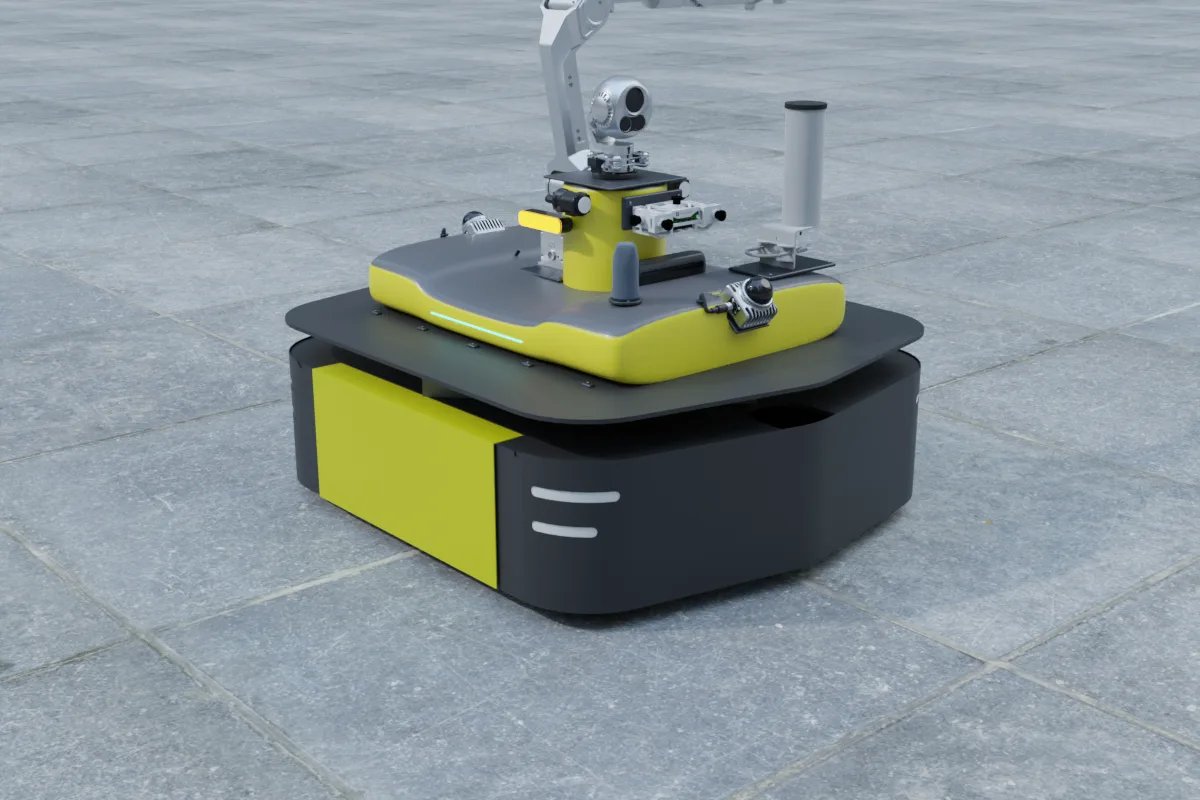
Arm options with real numbers
The table lists arms we keep in our payload catalog with manufacturer-listed weight, rated payload and reach. All are far below the Ridgeback's payload rating, so choose by task.
| Arm | Axes | Arm weight | Rated payload | Reach | Typical use on a Ridgeback |
|---|---|---|---|---|---|
| Kinova Gen3 lite | 6 | 5.4 kg | 0.5 kg | 760 mm | teaching, light pick and place, button pressing |
| Kinova Gen3 7DoF | 7 | 8.2 kg | 2 kg | 902 mm | research manipulation where a redundant axis helps reach around obstacles |
| Unitree Z1 Pro | 6 | 4.5 kg | 3 kg | 740 mm | low-cost general manipulation |
| AgileX NERO | 7 | 4.8 kg | 3 kg | 580 mm | compact 7-axis work close to the base |
| RealMan RM65-B | 6 | 7.2 kg | 5 kg | 610 mm | tools, sample containers, machine tending |
| RealMan RM75-B | 7 | 7.8 kg | 5 kg | 610 mm | the same loads with an extra axis for cluttered cells |
Remember that the gripper, wrist camera and any tool changer count against the arm's rated payload, not just the object being lifted. A 5 kg arm with a 1 kg gripper is a 4 kg arm.
Where the arm goes on the deck
The Ridgeback body is about 960 mm long, 793 mm wide and only 296 mm high. That low deck is an advantage for floor-level tasks and a problem for bench-level ones: a typical workbench surface sits several hundred millimetres above the arm's base, so an arm with around 600 mm of reach spends much of it just getting up to the work.
- Floor and low-shelf tasks: mount the arm directly on a reinforced plate near one edge of the deck so the tool can reach past the body.
- Bench, shelf and panel tasks: put the arm on a riser or column so its shoulder sits near working height. The riser must be stiff; a tall thin column turns every base stop into an oscillation at the tool.
- Both: choose a longer arm such as the Kinova Gen3, or accept a fixed riser and use the base to do the reaching.
Our arm reinforcement base (a stiffened mounting plate with a flange interface, 2.1 kg in our catalog) spreads the arm's reaction loads into the chassis mounting points instead of a thin cover. Keep the arm's swept volume clear of the LiDAR and antennas, and check the folded transport pose fits inside the footprint so the robot can pass through doors.
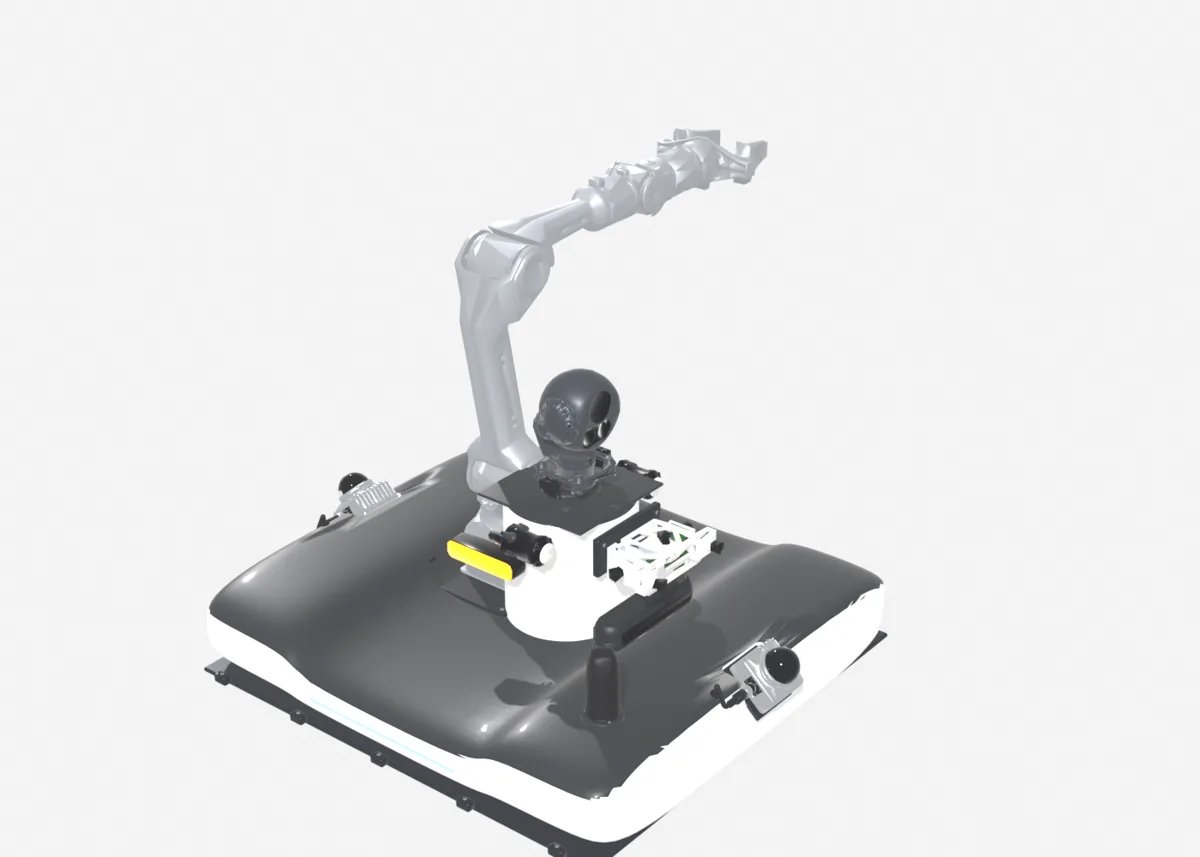
Sensors: what the base needs and what the arm needs
Split sensing into two jobs. The base needs to localise and avoid obstacles; the arm needs to see the object.
- Base: a 3D LiDAR such as the Livox Mid-360 (265 g, 6.5 W) on a short mast gives mapping, localisation and obstacle detection above deck height. Because the arm will shadow part of its view, either mount it forward of the arm or filter arm points using the joint states.
- Arm: a wrist-mounted depth camera such as the Intel RealSense D435i (75 g, 2.5 W) sees the object from the tool's point of view and does not suffer from base positioning error. A second fixed camera looking at the workspace helps with coarse detection before the arm moves.
- Compute: a Jetson Orin NX 16GB module (up to 40 W) handles navigation plus one detection model; a Jetson AGX Orin 64GB (up to 60 W) leaves room for motion planning and heavier perception on the same board.
Weight and power budget: a worked example
| Item | Weight | Peak power |
|---|---|---|
| RealMan RM65-B arm | 7.2 kg | 150 W |
| Arm reinforcement base | 2.1 kg | none |
| Livox Mid-360 | 0.265 kg | 6.5 W |
| RealSense D435i | 0.075 kg | 2.5 W |
| Jetson AGX Orin 64GB module | not listed | 60 W |
| Total of listed items | about 9.6 kg | about 219 W |
Add the gripper, riser, carrier board, cables and enclosure and a realistic build is still a small fraction of the 100 kg rating. Weight is not the constraint; power quality is. Give the arm its own fused DC-DC rail sized for peak current, separate from the compute and sensor rail, so an arm stall cannot brown out the computer. Wire the emergency stop so it removes arm motor power as well as base drive power. Our guide to powering payloads from the robot battery covers converter sizing and protection.
Software: the part that takes the time
- Stopping accuracy. LiDAR localisation gets the base to within a few centimetres of a goal. For repeatable manipulation, add a final alignment step at each station using a fiducial marker or a known fixture seen by the wrist camera, then plan the grasp relative to that, not to the map.
- Hand-eye calibration. The transform between the wrist camera and the tool flange has to be calibrated and re-checked after any knock. Most grasp failures in new builds trace back to this.
- Base and arm coordination. The simplest safe scheme is sequential: arm folded while driving, base braked while the arm moves. Whole-body motion where the base moves during a reach is possible on an omnidirectional platform but needs more planning and testing work.
- Self-collision and deck collision. The planning model must include everything bolted to the deck, including the mast, antennas and riser, or the arm will find them.
The Ridgeback and most of the arms above have ROS 2 drivers from their manufacturers, and MoveIt 2 is the usual motion-planning layer. The integration work is in the robot description, calibration, task logic and recovery behaviour when a grasp fails.
When a different base is the better choice
If the robot must leave smooth floors, look at a Clearpath Husky A200 or a tracked chassis. If the arm is light and the aisles are narrow, the smaller Clearpath Dingo-D may be enough. If the Ridgeback fits, you can lay out the arm, LiDAR, cameras and compute on the Ridgeback platform page or in the payload configurator and see the running weight and power totals. YUANZHI ROBOTICS designs and builds the deck hardware under our UGV payload service and develops the navigation and manipulation software under our robot autonomy service.
FAQ
Can a Clearpath Ridgeback carry a robot arm?
Yes. The Ridgeback is listed at about 100 kg of payload, and common mobile-robot arms weigh about 4 to 8 kg. A full build with arm, mounting base, 3D LiDAR, depth camera and compute typically uses around a tenth of the rating.
Which robot arm is best for a Ridgeback mobile manipulator?
It depends on the task. Kinova Gen3 arms offer the longest reach (about 890 to 900 mm) with 2 kg payload; the RealMan RM65-B carries 5 kg with 610 mm reach; the Unitree Z1 Pro and AgileX NERO carry 3 kg at lower weight. Because the base is omnidirectional, payload and stiffness often matter more than reach.
Does the arm need a riser on a Ridgeback?
For bench-height or shelf work, usually yes. The Ridgeback body is only about 296 mm high, so a riser brings the arm shoulder near working height. For floor-level tasks, mount the arm low and near the deck edge.
Can a Ridgeback mobile manipulator work outdoors?
It is an indoor platform. Omnidirectional wheels need flat, hard floors; for gravel, kerbs or rough ground a four-wheel-drive or tracked base such as a Husky A200 or AgileX Bunker is a better choice.
Who can integrate an arm and sensors on a Clearpath Ridgeback?
A payload integrator such as YUANZHI ROBOTICS can design the mounting base and riser, the power rails and sensor layout, and develop the ROS 2 navigation and manipulation software.