Mounting a robot arm on an AgileX Bunker: base plate, power and reach
Updated 2026-11-09 · YUANZHI ROBOTICS engineering team
Short answer: an AgileX Bunker can carry a lightweight 6- or 7-axis arm with plenty of margin. The standard Bunker is listed at about 145 kg with roughly 70 kg of payload, so a 4 to 8 kg arm is a small share of the budget. The hard parts are not the weight but the base plate stiffness, a clean power rail for the arm controller, reach that still clears the tracks and deck sensors, and software that stops the arm moving while the tracks are driving. This guide walks through those four decisions with real numbers.
Which Bunker: Mini, standard or Pro
AgileX sells three tracked chassis in the Bunker family. Their size and payload decide how big an arm makes sense and how much room is left for cameras, LiDAR and compute around it.
| Chassis | Size L x W x H (mm) | Weight | Rated payload | Arm class that fits well |
|---|---|---|---|---|
| Bunker Mini | 660 x 584 x 281 | about 54.8 kg | about 35 kg | light arms of 2 to 5 kg; deck space is the real limit |
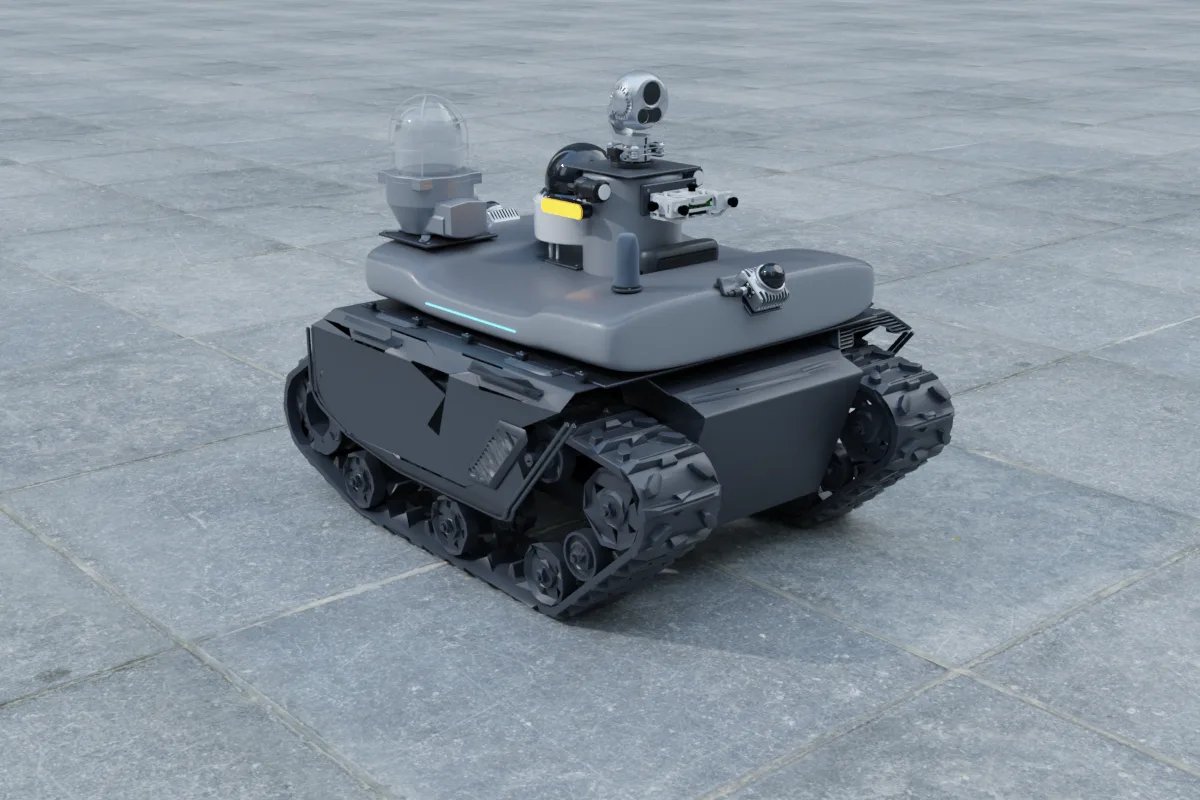
| Bunker | 1023 x 778 x 400 | about 145 kg | about 70 kg | 4 to 8 kg arms plus a full sensor mast |
| Bunker Pro | 1064 x 845 x 473 | about 150 kg | about 120 kg | heavier arms, tool changers or a sample box beside the arm |
Figures are the manufacturer's listed values as recorded in our payload catalog. For most inspection and light-manipulation work (opening a cabinet door, pressing a button, placing a sensor, taking a sample) the standard Bunker is the comfortable middle choice.
Choosing the arm: weight, payload and reach
Arms sold for mobile robots differ mostly in three numbers. Weight affects the base plate and centre of gravity, rated payload decides what the gripper can hold, and reach decides whether the arm can get past the edge of the tracks to the floor or up to a panel.
| Arm | Axes | Arm weight | Rated payload | Reach |
|---|---|---|---|---|
| AgileX PiPER | 6 | 4.2 kg | 1.5 kg | 626 mm |
| AgileX PiPER X | 6 | 4.5 kg | 1.5 kg | 669 mm |
| AgileX NERO | 7 | 4.8 kg | 3 kg | 580 mm |
| Unitree Z1 Pro | 6 | 4.5 kg | 3 kg | 740 mm |
| RealMan RM65-B | 6 | 7.2 kg | 5 kg | 610 mm |
| Kinova Gen3 6DoF | 6 | 7.2 kg | 2 kg | 891 mm |
| Kinova Gen3 lite | 6 | 5.4 kg | 0.5 kg | 760 mm |
Two practical rules from integration work. First, the rated payload is a static figure; when the chassis is pitching on rough ground, plan to lift well under the rating. Second, measure reach from where the arm base will actually sit. On a Bunker the chassis is about 400 mm high, so an arm mounted in the middle of the deck with a 626 mm reach may not get to the ground beside the tracks at all. If floor pickup matters, mount the arm near the front edge or on a raised, forward-offset pedestal, and check the full arc against the tracks and any front sensors.
The base plate and mounting
The arm should never be bolted to a cosmetic deck cover. Its reaction forces, especially during fast moves or a sudden stop of the chassis, go straight into whatever it is bolted to. A sound layout looks like this:
- An aluminium or steel adapter plate that bolts to the chassis' structural mounting points, not to a shell.
- The arm's own bolt pattern machined into that plate, with dowel pins or a locating register so the arm goes back in the same place after service and the hand-eye calibration still holds.
- Stiffening ribs or a short pedestal under the arm base, sized so the plate does not flex visibly when the arm swings at full reach with its rated load.
- Cable exits routed under the plate to the electronics bay, with strain relief where the arm cable leaves the base.
The arm also moves the centre of gravity. On a tracked chassis this matters on slopes and when crossing steps: with the arm stretched forward and a load in the gripper, the combined centre of gravity shifts toward the front of the tracks. A simple stow pose for driving, with the arm folded low over the deck, solves most of this.
Power for the arm and the rest of the payload
Arm power figures vary widely and several manufacturers do not publish a clear average. Where data exists, the NERO is listed at about 60 W and the RealMan RM65-B at about 150 W, and peak current during fast multi-joint moves is higher than the average. Plan the power rail around peaks:
- A dedicated DC-DC converter or a separately fused output for the arm, so arm current spikes do not brown out the compute or the LiDAR.
- An emergency stop that cuts arm motor power, wired so a stop on the chassis also stops the arm.
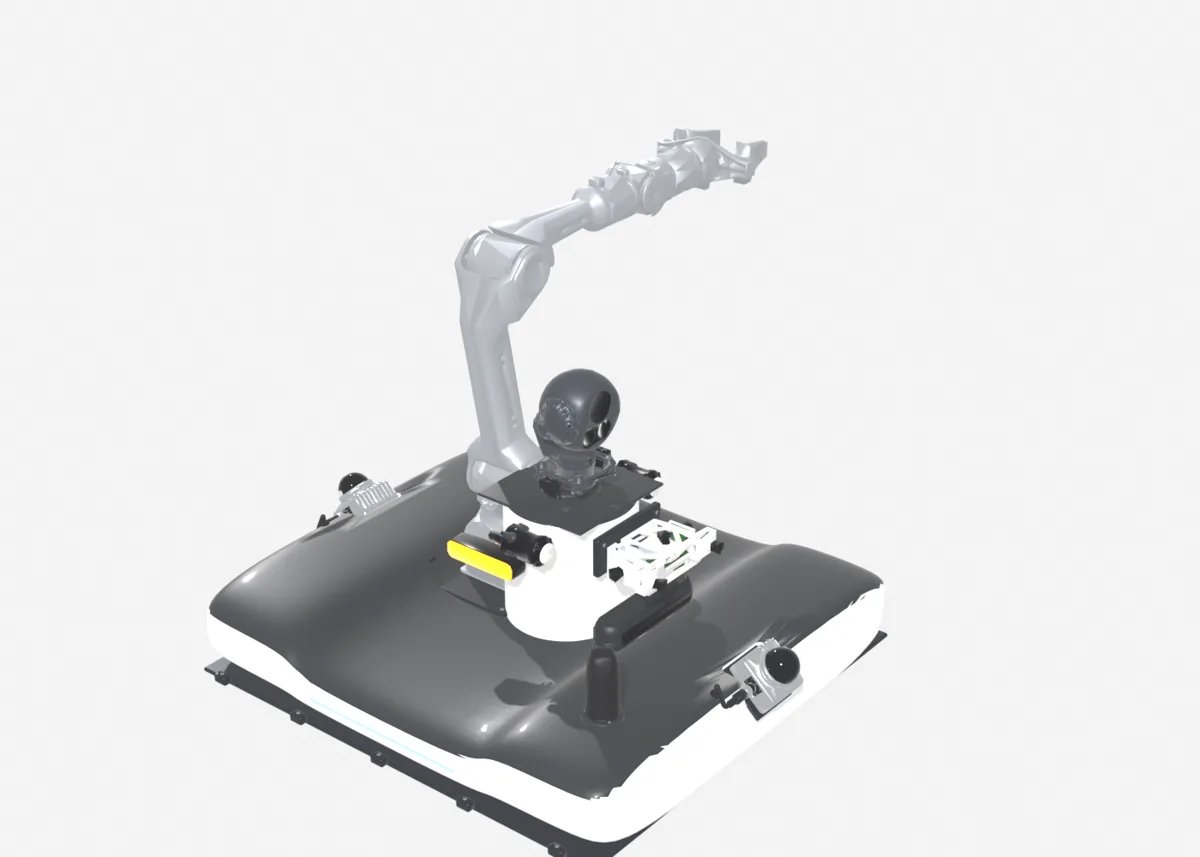
- A budget for everything else on the deck. As a reference point, our UGV demo payload (turret, PiPER 6-axis arm, front depth camera, rear Livox Mid-360, RTK antenna and warning light) adds up to about 15.7 kg and a peak of about 107 W from the parts with published data.
Our guide on powering robot payloads from the robot battery covers converter sizing and protection in more detail, and the weight and power budget guide shows how to add it all up.
Sensors and software around the arm
A mobile arm is only useful if it knows where the target is. The usual sensor set is a depth camera such as an Intel RealSense D435i (about 75 g, about 2.5 W) for grasping and a 360-degree LiDAR such as the Livox Mid-360 (about 265 g, about 6.5 W) for mapping and localising the chassis. Place the LiDAR where the arm cannot block it in its stow pose, and give the depth camera a clear view of the work zone.
On the software side, the integration work usually covers:
- ROS 2 drivers for the chassis, arm, camera and LiDAR on one onboard computer, with a single TF tree.
- Hand-eye calibration between the camera and the arm base.
- An interlock so the arm only moves when the chassis is stopped, or only within a safe envelope while driving.
- A mission sequence: navigate to a work point, fine approach using the camera, run the arm task, stow and drive on.
Next step
You can lay out a Bunker with an arm, LiDAR and cameras in our payload configurator and see the running weight and power totals, or start from the AgileX Bunker, Bunker Pro and Bunker Mini platform pages. YUANZHI ROBOTICS designs UGV payloads including arm base plates and power rails, and develops the navigation and manipulation software that ties the arm to the chassis.
FAQ
Can an AgileX Bunker carry a robot arm?
Yes. The standard Bunker is listed at about 70 kg of payload and the Bunker Pro at about 120 kg, while common mobile-robot arms weigh about 4 to 8 kg. Deck space, base plate stiffness and power are the real constraints.
Which robot arm is best for an AgileX Bunker?
For light inspection and manipulation, the AgileX PiPER (4.2 kg, 1.5 kg payload, 626 mm reach) integrates easily. For heavier objects, a Unitree Z1 Pro or AgileX NERO (3 kg payload) or a RealMan RM65-B (5 kg payload) fits. The Kinova Gen3 gives the longest reach, about 891 mm.
Can the arm reach the ground from a Bunker?
Often not from the middle of the deck, because the chassis is about 400 mm high. Mount the arm near the front edge or on a forward-offset pedestal and check the full arc against the tracks before committing.
How do I power a robot arm on a UGV?
Use a dedicated DC-DC converter or fused output sized for the arm's peak current, keep it separate from the compute and LiDAR supply, and wire the emergency stop to cut arm motor power.
Who can integrate a robot arm on an AgileX Bunker?
A payload integrator such as YUANZHI ROBOTICS can design the base plate, power rail and sensor layout and develop the ROS 2 navigation and manipulation software.