Custom payloads for the DJI Matrice 400: what can be integrated and how
Updated 2026-11-09 · YUANZHI ROBOTICS engineering team
Short answer: the DJI Matrice 400 is listed at about 9.74 kg with roughly 6 kg of payload and up to 59 minutes of flight time, which is enough to carry a Zenmuse gimbal and a second, custom payload at the same time: a 3D LiDAR, a gas-sensing pod, a loudspeaker, an onboard AI computer or a long-range mesh radio. What decides success is not the headline payload but four things: a balanced and vibration-isolated mount, a power and data path the drone accepts, time-synchronised data, and software that turns raw sensor output into a result your team can use.
What the Matrice 400 already gives you
Before adding anything, list what is built in. The Matrice 400 has its own RTK positioning and obstacle-sensing radar, and it carries DJI Zenmuse gimbals natively. If a Zenmuse H30T, L2 or P1 already answers your question, buy that and stop: DJI payloads are calibrated, supported in DJI Pilot and FlightHub, and need no custom work. Custom integration is worth it when you need a sensor DJI does not make, an onboard computer, your own data path, or several sensors flying together.
| Matrice 350 RTK | Matrice 400 | |
|---|---|---|
| Aircraft weight | about 6.47 kg | about 9.74 kg |
| Rated payload | about 2.7 kg | about 6 kg |
| Size (unfolded, mm) | 810 x 670 x 430 | 980 x 1020 x 470 |
| Typical custom use | one gimbal or one light sensor pod | gimbal plus a second payload, or a heavier combined pod |
Values are manufacturer listings as recorded in our payload catalog; check DJI's current specification before final design.
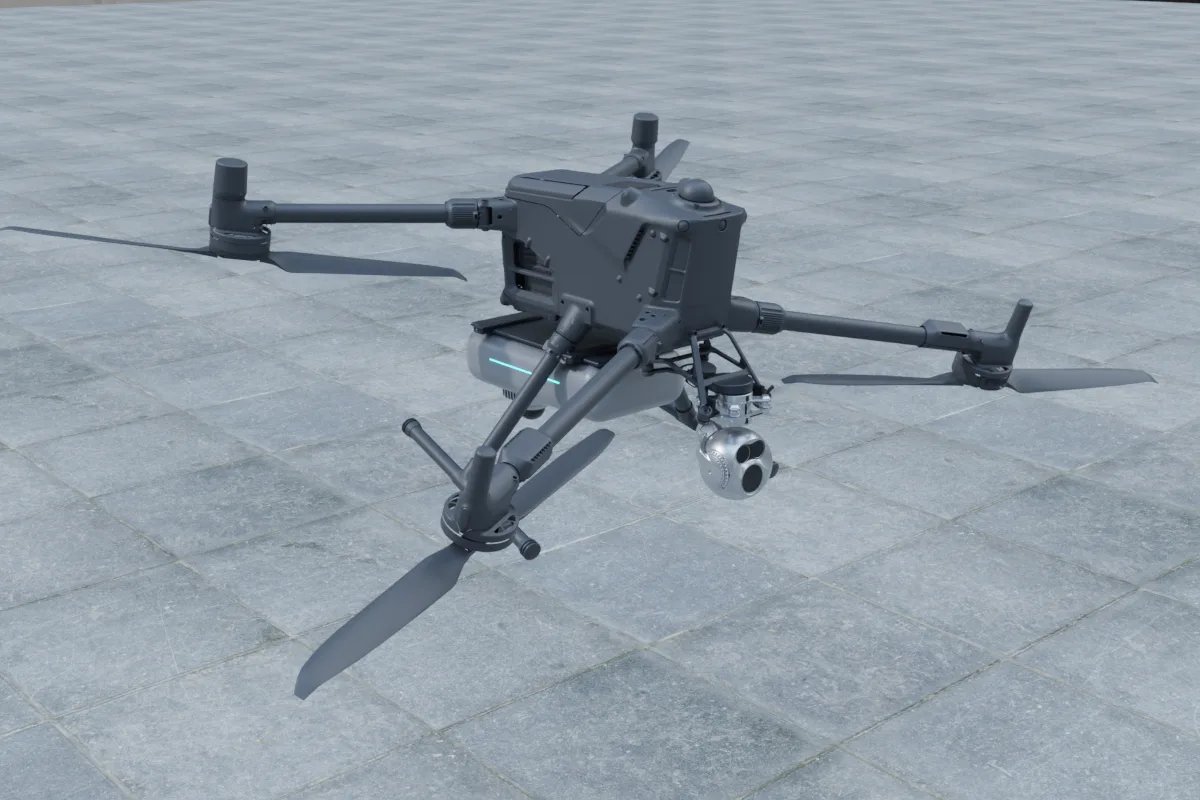
What people actually integrate
These are the payload classes we are asked about most often, with real weights and power from our component catalog. Weights are for the sensor itself and exclude bracket, cables and enclosure.
| Payload class | Example parts | Weight | Power | Why on a drone |
|---|---|---|---|---|
| Compact 3D LiDAR | Livox Mid-360 / Hesai JT16 / Hesai XT32M2X | 265 g / 200 g / 490 g | 6.5 W / 4.3 W / 10 W | low-altitude mapping under canopy, in tunnels or around structures where a survey LiDAR is overkill |
| Gas sensing | ION Science MiniPID 2 (VOC) + Winsen ZCE04B (4-in-1) | 40 g + 50 g | low (sensor level) | leak screening along pipelines, landfills and plant fences |
| Thermal core for custom pods | Teledyne FLIR Boson 640 | 7.5 g | 0.5 W | radiometric or AI thermal channel in your own housing |
| Broadcast and light | DJI Zenmuse V1 / S1 | 690 g / 760 g | – | security, rescue and crowd guidance |
| Onboard compute | NVIDIA Jetson Orin Nano 8GB / Orin NX 16GB / AGX Orin 64GB module | module only; add carrier and heatsink | about 25 W / 40 W / 60 W | detection, mapping or tracking in flight |
| Long-range data link | Doodle Labs Mini / Silvus SC4200 OEM / Quectel RM520N-GL 5G | 34 g / 116 g / module | about 5 W / – / – | raw data off the aircraft, independent of the DJI link |
As a worked example, a Zenmuse H30T (920 g) plus a Livox Mid-360 (265 g) is about 1.19 kg of sensors, roughly 20% of the rated payload. That leaves real room for a compute box, bracket and cabling, which on a drone often weigh as much as the sensors themselves.
Step 1: mount, balance and vibration
A drone payload is a mechanical design problem first. The centre of gravity of the whole payload should sit close to the aircraft's own, or the flight controller spends thrust correcting a constant tilt and flight time drops. LiDARs and IMU-dependent sensors need vibration isolation tuned to the propeller frequencies, but not so soft that the sensor wobbles relative to the RTK antenna, because every millimetre of unmodelled motion becomes error in the point cloud. We design form-fitting brackets around the aircraft's mounting interfaces and keep the sensor's field of view clear of the landing gear and propellers.
Step 2: power and data path
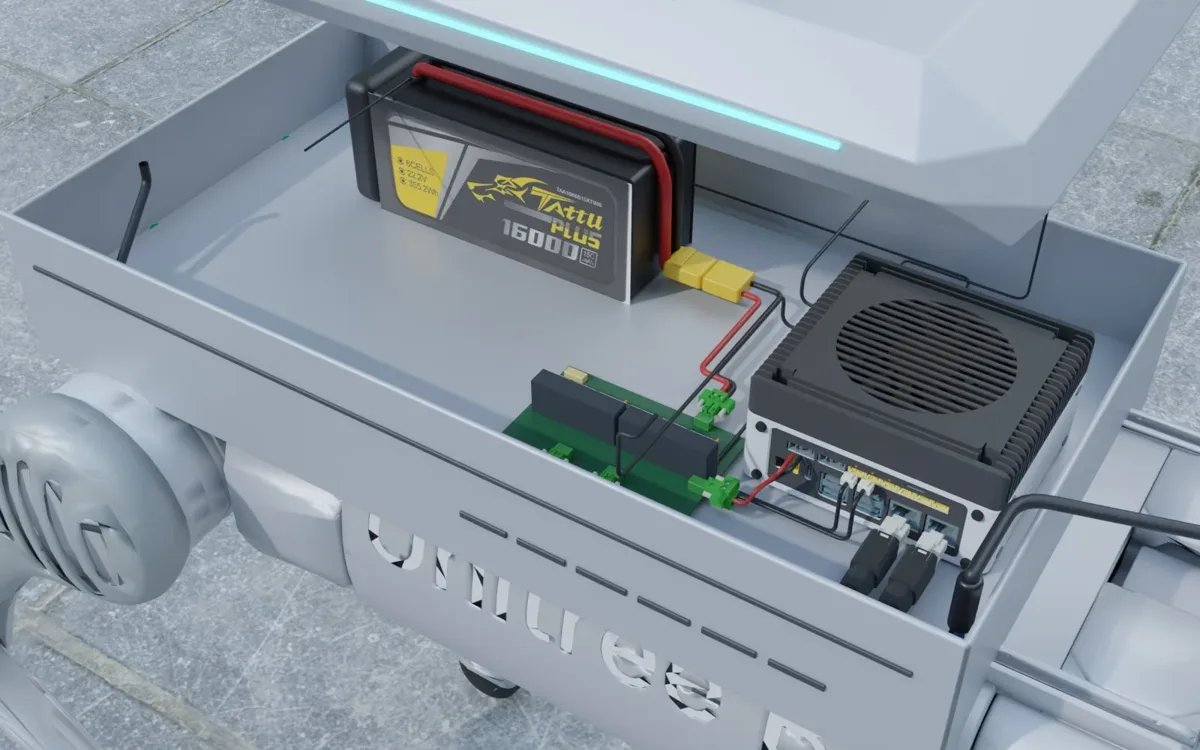
There are two routes. The first is DJI's Payload SDK (PSDK) path: the payload talks to the drone through DJI's payload interface, shows up in DJI Pilot, can receive aircraft position and time, and can send small amounts of data back to the pilot. This is the cleanest option for anything the pilot needs to see or control. The second route is an independent power supply and radio for high-bandwidth or power-hungry parts, for example a Jetson AGX Orin or a full-rate LiDAR stream, which would exceed what a payload port is meant to provide. Many real payloads combine both: PSDK for control and position, an isolated rail and a mesh or 5G link for the heavy data.
Step 3: time and position
A custom sensor is only as useful as its timestamps. LiDAR scans, thermal frames and gas readings must share a clock with the aircraft's RTK position and attitude, through PPS and time messages or a hardware trigger. Without that, the map smears and a gas peak cannot be tied to a location. If you need heading from a separate GNSS receiver, a dual-antenna module such as the Unicore UM982 weighs under 2 g on its board; the antennas and their separation are the real design constraint.
Step 4: software and ground station
Most of the engineering hours go here. Typical work includes a ROS 2 driver set for the added sensors, onboard detection on the gimbal video, LiDAR-inertial mapping, and a ground-station view that overlays results on a map and exports reports. For pipeline or tunnel work we usually treat the drone as one asset alongside robot dogs and UGVs, which is covered in our guide on tunnel inspection payloads. For a choice between an integrated drone and a payload drone, see Matrice 4T or a custom payload drone.
Common mistakes
- Budgeting only sensor weight and forgetting bracket, cables, enclosure and cooling.
- Mounting a LiDAR where the landing gear or a propeller crosses its field of view.
- Running a high-power computer from the payload port instead of a sized, fused supply.
- Logging sensor data with the computer's clock rather than the aircraft's RTK time.
- Choosing a custom sensor when a calibrated Zenmuse payload would have done the job.
Next step
To see how sensors fit on the airframe, open the 3D payload configurator and pick the Matrice 400, or read the Matrice 400 platform page and compare it with the Matrice 350 RTK. Our drone payload integration service covers bracket design, wiring, PSDK work and the ground station, and robot autonomy covers mapping and detection software. Send us your sensor list and mission and we will reply with a feasibility check and a function list.
FAQ
How much payload can the DJI Matrice 400 carry?
DJI lists about 6 kg of payload for the Matrice 400. Flight time drops as payload rises, so plan your sensors, brackets, cables and any onboard computer as one weight budget and leave margin for wind.
Can I put a non-DJI LiDAR on a Matrice 400?
Yes. Lightweight 3D LiDARs such as the Livox Mid-360 (about 265 g, 6.5 W) or Hesai JT16 (about 200 g, 4.3 W) are common choices. They need a rigid bracket, a clean power supply, time synchronisation and software that fuses the scan with the drone's RTK position and attitude.
Can a Matrice 400 run AI detection onboard?
Yes, with an added computer such as an NVIDIA Jetson Orin NX 16GB module (up to 157 TOPS, around 40 W module power). It runs detection on the gimbal video or third-party sensors in flight and sends only results or alarms over the link.
Who can build a custom payload for the DJI Matrice 400?
System integrators who design the mechanical mount, power, data link and software together. YUANZHI ROBOTICS designs and integrates custom payloads for the Matrice 400, Matrice 350 RTK and other industrial drones, including the ground-station software.
Is the Matrice 400 better than the Matrice 350 RTK for custom payloads?
For heavier or combined payloads, usually yes: about 6 kg of rated payload against about 2.7 kg for the Matrice 350 RTK. The 350 RTK remains a good choice when a single gimbal or a light sensor pod is all you need.