Robot dog payload for tunnel and utility corridor inspection
Updated 2026-11-01 · YUANZHI ROBOTICS engineering team
Cable tunnels, utility galleries, metro service corridors and drainage tunnels share the same inspection problem: they are long, dark, often wet, sometimes gassy, and people should enter them as little as possible. A robot dog with the right payload walks them on a schedule and brings back readings and images. This guide describes what that payload carries, how the robot finds its way with no GNSS, how it talks to the outside, and what the software does with the data.
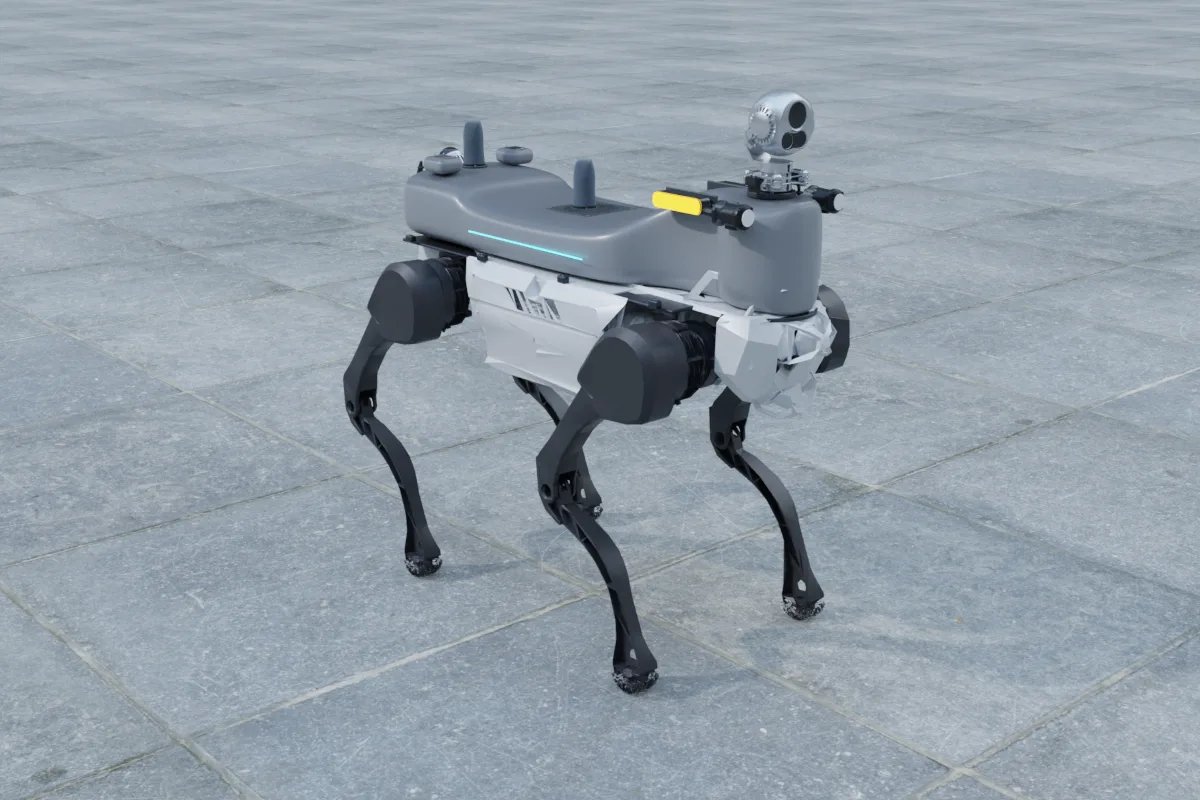
What the tunnel asks of the robot
Tunnels differ from substations and plants in four ways that shape the payload. There is no GNSS, so the robot localizes on its own map. Light is poor or absent, so the payload brings its own. Radio does not reach far around bends and through concrete, so the communications plan is part of the design. And the hazards are atmospheric: oxygen deficiency, methane in drainage and sewer tunnels, carbon monoxide after fires or from traffic, hydrogen sulphide where there is standing water. The robot walks so that a person does not have to, and its first job is to measure those gases before anyone follows.
The ground is also harder than a plant floor: steps at bulkheads, cable trays and pipes across the walkway, standing water, grating, and ladders or stairs between levels. This is why a quadruped is chosen over a wheeled robot for most tunnel work; a tracked UGV is adequate only in dry, flat galleries with no obstacles across the route.
Sensors on the payload
- LiDAR (Livox Mid-360 class) on top of the payload for mapping and localization, with a 360 degree view over the robot's body.
- Thermal and visible camera head on a two-axis pan-tilt: a radiometric thermal camera for cable joints, busbars, transformers and pumps, and a visible zoom camera for labels, indicators and water marks on the wall.
- Gas block with a pump and modules for oxygen, methane and combustible gas, carbon monoxide and hydrogen sulphide; sewer and drainage tunnels add ammonia, chemical corridors add the site's specific gases.
- Environmental sensor: air temperature, humidity, and a downward range sensor for water depth on the walkway.
- Partial-discharge probe (TEV, with an acoustic imager where joints are exposed) in high-voltage cable tunnels, for joints and terminations.
- Structural camera: a high-resolution visible camera with its own flash, pointed at the lining, for crack, spalling and seepage imaging in civil tunnels.
- Lighting: 20 to 40 W of LED flood lighting on the head and body, switched by the software per inspection point, because the visible camera and the structural camera need it and the thermal camera does not.
- Audio: a microphone and speaker for two-way communication with a person in the tunnel and for abnormal-noise detection at pumps and fans.
Complete, with compute, 5G and Wi-Fi modules, own battery and an aluminium shell, this payload is 8 to 11 kg on a Unitree B2 or DEEP Robotics X30, and draws 50 to 70 W typical with lighting off and up to 120 W with lighting on.
Navigation without GNSS
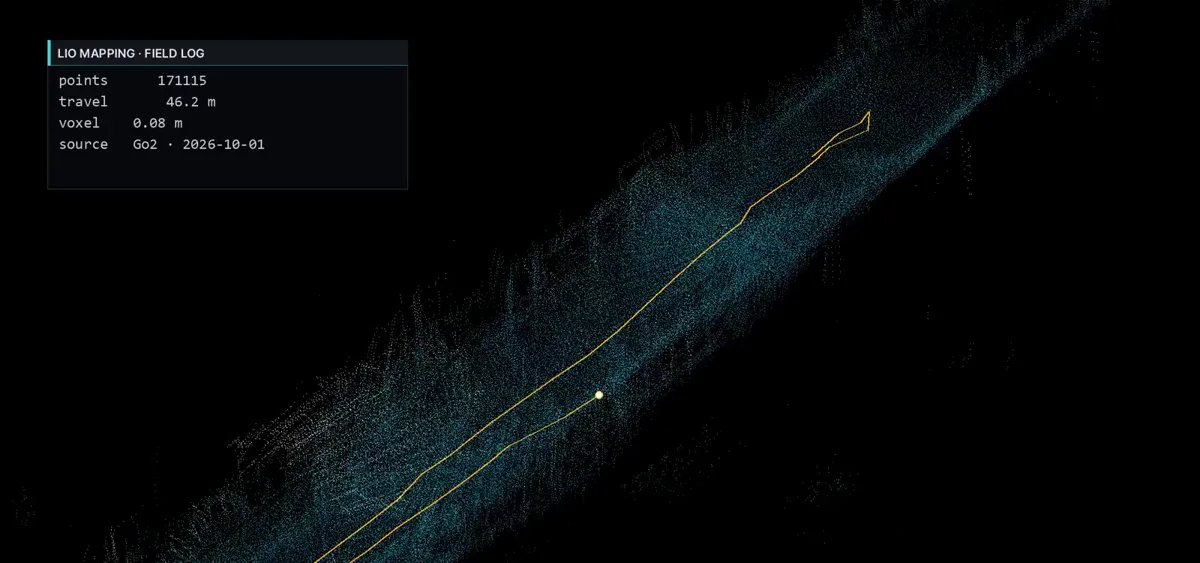
On the first visit an operator walks the robot through the corridor with the LiDAR recording, and the software builds a map. The route and the inspection points are then defined on that map in a browser: each point has a position, a heading, the head angles, the sensors to read and the lighting state. On every later round the robot localizes itself on the map with the LiDAR, the leg odometry and the IMU.
Tunnels are hard for SLAM in one specific way: a long straight section with identical cable brackets every few metres looks the same everywhere, and position along the tunnel drifts. The software handles this by fusing odometry over those sections and re-locking at distinctive features such as bulkhead doors, junction chambers, equipment niches and the painted distance markers most tunnels already have. Where a tunnel has none, a few reflective markers at known positions fix the problem.
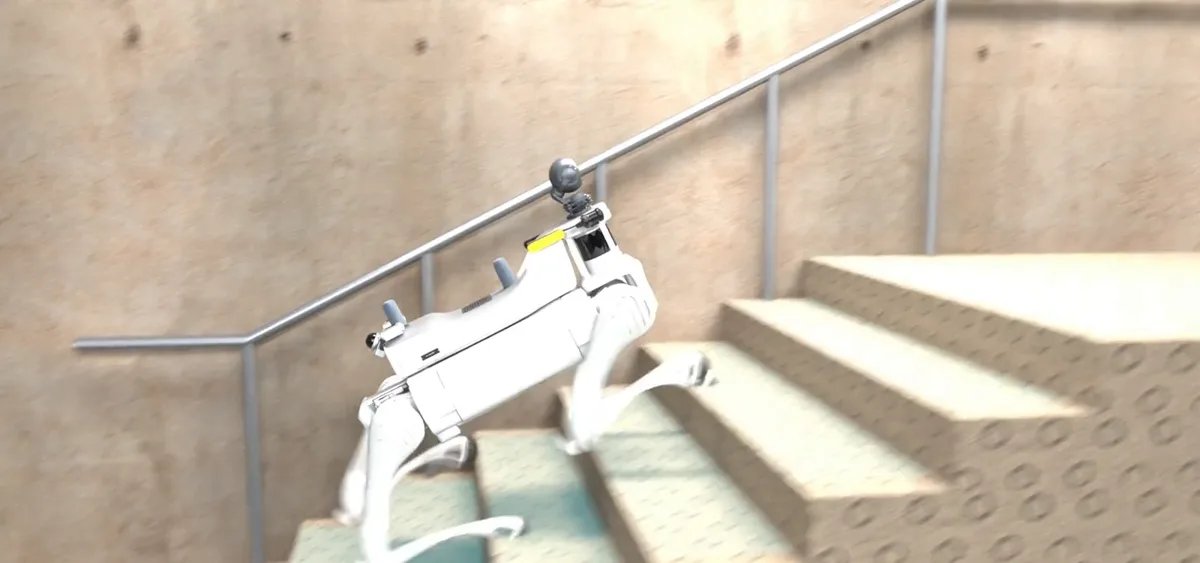
Obstacle handling is part of navigation: a depth camera at the front detects new objects on the walkway (tools, hoses, a fallen bracket), and the robot steps over, walks around or stops and reports, depending on the size. Steps and stairs are climbed by the quadruped's own controller; the payload only has to keep its mass low and central so that the robot's gait is not disturbed.
Communications underground
Radio in a tunnel reaches a few hundred metres on a straight section and much less around bends. The payload is designed for three cases:
- Tunnel with infrastructure: many cable tunnels and all metro tunnels have Wi-Fi, LTE or a leaky feeder. The payload's 5G and Wi-Fi modules use it, and live video and remote control work everywhere.
- Mesh nodes: for tunnels without coverage, battery Wi-Fi mesh nodes are mounted every 150 to 300 metres, or the robot carries and drops a few on its way in and collects them on the way out.
- Store and forward: the robot runs the round with no link, records every reading and image with position and time, and uploads at the access shaft or dock. Alarms are prioritized in the upload. Only live viewing is lost; the inspection itself is complete.
In every case the robot continues the round when the link drops; a lost link never stops the robot in the tunnel.
Power and runtime
The payload runs from its own 48 V battery, so the robot keeps its rated runtime and the payload stays on at the dock. A B2 or X30 with a 10 kg payload walks a tunnel for roughly 1.5 to 2 hours at inspection pace, which covers a 2 to 3 km round with 40 to 60 inspection points. Longer corridors are divided into rounds between charging docks at access shafts, or the robot is driven to the next access point by vehicle. Lighting is the largest variable load, so it is switched per inspection point and off while walking when the depth camera can see enough with infrared illumination.
Protection
The payload shell is sealed aluminium with cable glands and a conductive path from the compute module to the shell; sensors keep their own ingress ratings and the gas intake has a water trap and a replaceable filter. The robot itself carries its manufacturer's ingress rating, and the complete system is tested with a wet round before shipping. In tunnels classified as hazardous areas (some sewer and gas-utility tunnels) a certified explosion-protected robot is required and a standard quadruped cannot be used; the gas block on a standard robot is for the many tunnels that are not classified but can still accumulate gas.
What the software does
- runs the round on schedule, with a gas check at the entrance before the robot goes in, and an immediate stop and report if a gas threshold is crossed anywhere;
- at each point reads thermal regions against reference, images the equipment or lining, logs gas and environmental values and stores everything with pose and time;
- compares images and readings with previous rounds, so a new water mark, a warmer joint or a rising methane level at the same point becomes an alarm;
- stitches the structural camera images along the lining into a position-indexed strip that an engineer can scroll through;
- pushes reports and events to the owner's maintenance system through an API, and runs on the robot and an on-site server with no cloud dependency.
Choosing the robot
For most tunnels we specify a Unitree B2 or a DEEP Robotics X30: both carry the complete payload, climb stairs and steps, have an ingress rating, and run long enough for a useful round. A DEEP Robotics M20 or a Unitree Go2 carries a reduced payload (LiDAR, camera head, small gas block, no own battery) for short, dry galleries. A tracked UGV such as an AgileX Bunker suits flat, dry cable galleries where the route has no steps and the operator wants longer runtime and a heavier payload.
If you have a tunnel or corridor to inspect, send us its length, the type (cable, utility, drainage, metro), the hazards and what is in it, and whether it has communications coverage; we will tell you which robot and which payload we would propose.
FAQ
Which sensors does a tunnel inspection robot dog need?
A LiDAR for mapping and localization, a thermal and visible camera head for cable joints, busbars and equipment, a gas block for oxygen, methane, carbon monoxide and hydrogen sulphide, an environmental sensor for temperature, humidity and water level, and lighting. Structural inspection adds a high-resolution visible camera for crack and seepage imaging; cable tunnels add a partial-discharge probe for joints and terminations.
How does the robot navigate without GNSS?
By LiDAR SLAM on a map built during the first walk. Tunnels are repetitive, so the software uses the LiDAR together with the robot's leg odometry and IMU, and adds reference features such as door frames, cable brackets and distance markers to keep the position locked over long straight sections.
How does the robot communicate underground?
Three options, often combined: Wi-Fi mesh nodes installed in the tunnel or dropped by the robot, an existing leaky feeder or LTE system in the tunnel, or a store-and-forward mode in which the robot records everything and uploads when it reaches a point with coverage. Rounds continue without a link; only live video needs one.
Which robot is suitable for tunnels?
A Unitree B2, DEEP Robotics X30 or another quadruped rated for several kilograms of continuous walking payload with an ingress rating for wet floors. Quadrupeds handle steps, pipes, cable trays and the ladders between levels that wheeled robots cannot. For dry, flat cable galleries a tracked UGV is also an option.
How long does a round take?
A quadruped walks about 1 m/s and stops for 10 to 30 seconds at each inspection point. A 2 km cable tunnel with 40 points takes roughly 1 to 1.5 hours, within one battery charge for the robot and the payload. Longer corridors are split into rounds from charging docks placed at access shafts.