Unitree Go2-W vs Go2 EDU: which one to choose for a sensor payload
Updated 2026-11-08 · YUANZHI ROBOTICS engineering team
Unitree sells the Go2 as a walking quadruped in several versions, with the EDU version open for secondary development, and the Go2-W as a wheel-legged variant with a powered wheel at the end of each leg. Both carry roughly the same payload, so the choice for a sensor payload project comes down to terrain, speed, runtime, what sensors are already on board, and how the robot moves while it maps. This guide compares the two on Unitree's public specifications, says where a figure is not published, and ends with a decision table by use case.
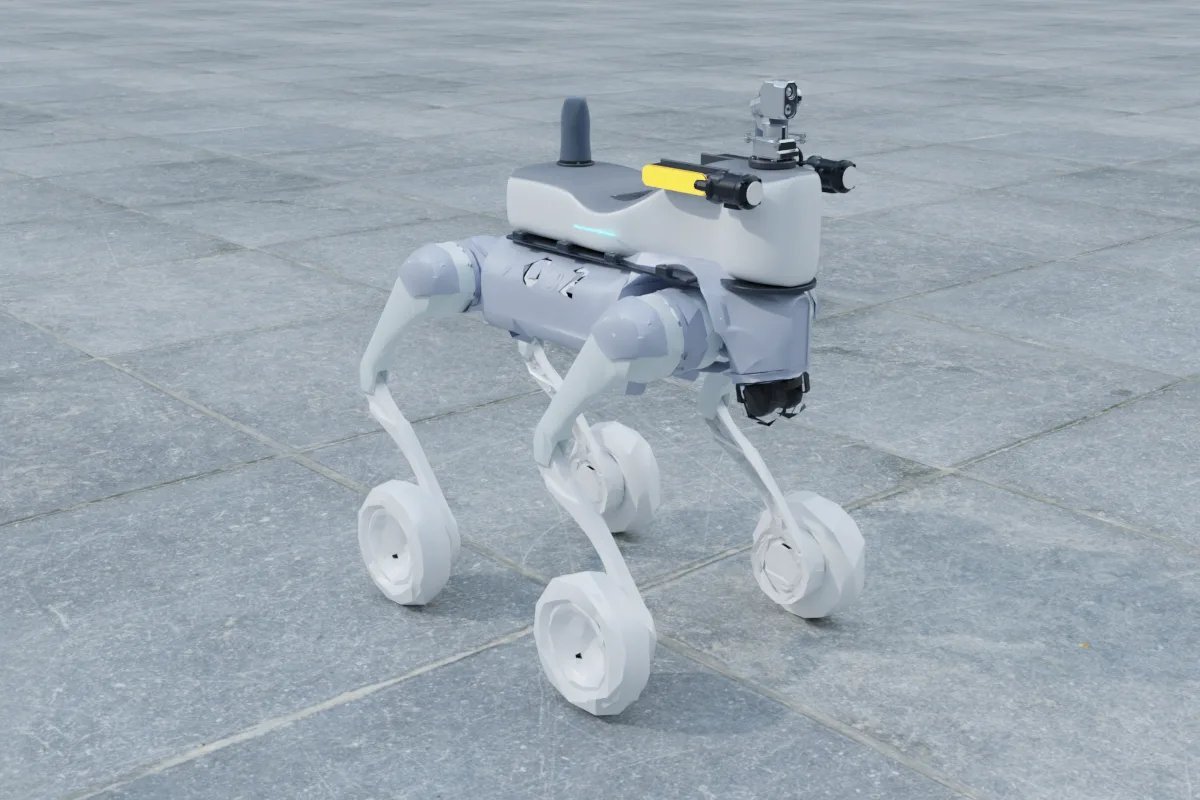
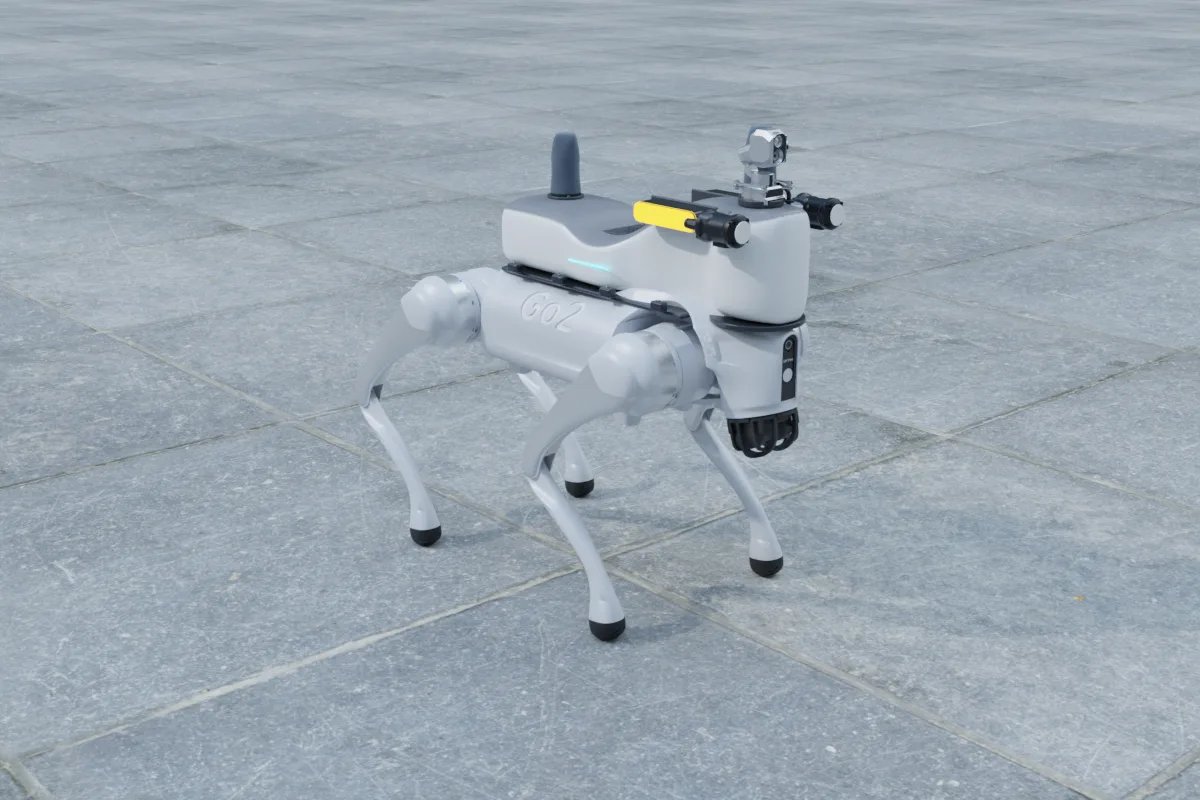
Specifications side by side
| Go2 EDU (walking) | Go2-W (wheel-legged) | |
|---|---|---|
| Weight with battery | About 15 kg | About 18 kg |
| Standing size | 70 x 31 x 40 cm | 70 x 43 x 50 cm |
| Payload | About 8 kg, maximum about 12 kg | About 8 kg, maximum about 12 kg |
| Speed | 0 to 3.7 m/s (maximum about 5 m/s) | 0 to 2.5 m/s |
| Battery and runtime | 15,000 mAh, about 2 to 4 h | 15,000 mAh, about 1.5 to 3 h |
| Charger | 33.6 V 9 A fast charger | 33.6 V 9 A fast charger |
| Climbing | Step about 16 cm, slope 40 degrees | Climb or drop height under 70 cm, slope 35 degrees; no stair step height published |
| Drive | Walking legs | 16 joint motors and in-wheel motors (Unitree does not say whether the 16 include the wheels), 7-inch pneumatic tyres |
| LiDAR | Unitree 4D LiDAR L2 | "Super-wide-angle 3D LiDAR", model not named on the product page |
| Cameras | HD wide-angle camera plus depth camera | HD wide-angle camera; depth camera not listed |
| Foot force sensors | Included | Not listed |
| Computing | 8-core CPU, optional Orin high-compute module (40 to 100 TOPS) | 8-core CPU, expansion modules such as Orin NX |
| Secondary development | Included | Listed, with reference to a secondary development manual |
| Payload mounting area | Dimensions not published | Dimensions not published |
| Noise, floor marking, IP rating | Not published | Not published |
All figures are from Unitree's product pages for the Go2 and Go2-W at the time of writing. Unitree does not publish a Go2-W version named EDU on its own site; resellers list several Go2-W configurations, and their compute and interface details differ, so confirm the exact configuration with your supplier before ordering.
Weight, payload and runtime
The Go2-W is about 3 kg heavier but Unitree gives it the same nominal payload as the Go2 EDU: about 8 kg, up to about 12 kg. In practice a sensor payload with a LiDAR, a camera module, a computer and a bracket stays well inside that range on either robot. Runtime is where they differ: both use a 15,000 mAh battery, but the published range is 2 to 4 hours for the Go2 EDU and 1.5 to 3 hours for the Go2-W. How much of the route is rolled and how much is walked will move the real figure. Plan inspection rounds on the lower end of the published range, and remember that the payload's own power draw comes out of the same battery.
Terrain and stairs
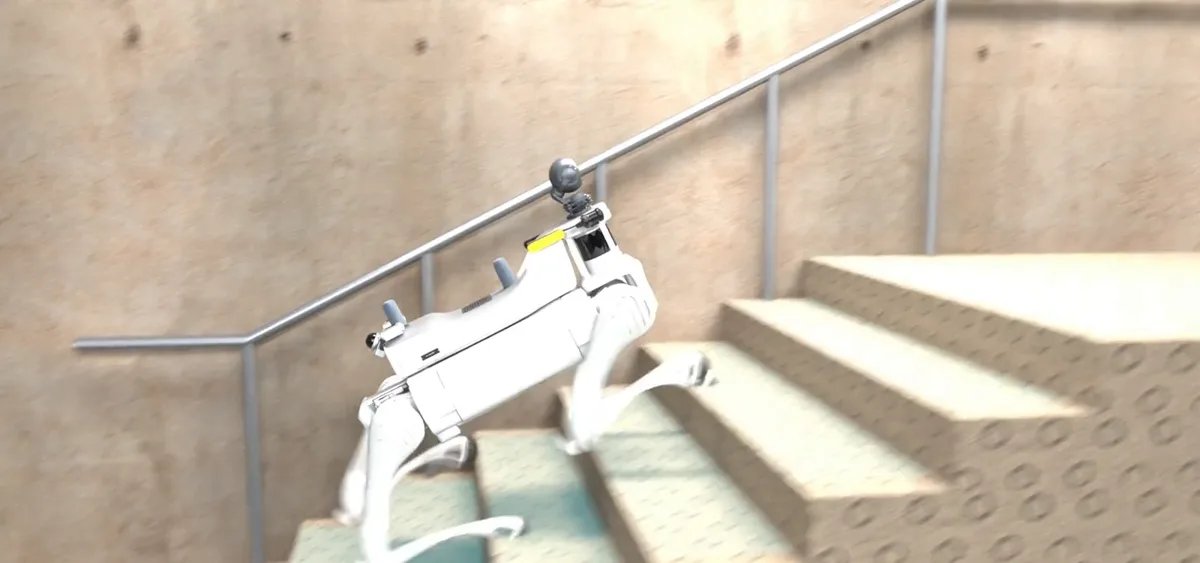
The Go2 EDU has a published step height of about 16 cm and a 40 degree slope. That covers most indoor stairs and kerbs when the gait and the terrain perception are set up properly. The Go2-W page advertises stair climbing and gives a climb or drop height of under 70 cm with a 35 degree slope, but does not give a step height for stairs in the same form as the Go2. Treat the 70 cm figure as an obstacle or drop capability, not as a stair specification, and test the actual stairs on your site before committing. The Go2-W is also slower at the top end: 2.5 m/s against 3.7 m/s for the Go2 EDU.
Noise and floor marks
Unitree does not publish noise levels or floor-marking behaviour for either robot. From the mechanics: a walking robot puts a short impact load on the floor with every step, while a wheel-legged robot rolling on pneumatic tyres has continuous contact and no footfall impacts on flat ground. For hospitals, offices, museums and other quiet indoor sites this is a reason to consider the Go2-W, but measure on the actual floor if noise or marks are part of the acceptance criteria.
Sensors already on board
The Go2 EDU page lists a 4D LiDAR L2, an HD wide-angle camera, a depth camera and foot-end force sensors. The Go2-W page lists a super-wide-angle 3D LiDAR and an HD wide-angle camera, without naming the LiDAR model and without a depth camera or foot force sensors. For a payload project the built-in sensors serve obstacle avoidance and close-range terrain; mapping, localization and inspection sensors usually go on the back either way, so the difference matters mainly if you planned to use the depth camera for the task itself.
Development access
Secondary development is an explicit feature of the Go2 EDU, and Unitree's open-source page lists unitree_sdk2 for the Go2. The Go2-W page also lists secondary development, refers to a secondary development manual and names expansion computing such as Orin NX, but Unitree's SDK pages do not list the Go2-W by name. Before you plan custom low-level control on the Go2-W, check the current manual for what is exposed, in particular wheel velocity commands and wheel state. For a payload that only needs high-level motion commands, robot state and a network link, either robot is workable.
Mounting area on the back
Unitree does not publish the dimensions of the usable mounting area on the back of either robot. The Go2-W standing width is 43 cm against 31 cm for the Go2, but much of that is the wheels. We design brackets from measured mounting points on the actual robot, keep the payload low and centred over the body, and check leg and wheel clearance through the full range of motion, including when the robot lies down.
What wheels change for mapping and navigation
- Smoother motion. On flat ground the body moves without the periodic pitch and roll of a gait. LiDAR-inertial odometry such as FAST-LIO2 or Point-LIO sees less vibration, and camera images have less motion blur.
- Odometry. In-wheel motors give a wheel-speed source that a walking robot does not have. On hard floors this can help as a velocity prior in the odometry; on gravel, wet surfaces or when the robot switches to stepping, wheel slip makes it unreliable, so the LiDAR and IMU remain the primary source.
- Motion model. Planners and controllers tuned for a walking robot need retuning for rolling: higher sustained speed on flat floors, different turning behaviour, and transitions between rolling and stepping that the navigation stack should treat as separate modes.
- Sensor height. The Go2-W stands 50 cm tall against 40 cm for the Go2, which changes the LiDAR's view of the floor and the blind zone around the robot. Calibrate extrinsics for each robot rather than copying them.
Decision table by use case
| Use case | Suggested platform |
|---|---|
| Indoor rounds on flat floors, long corridors, quiet sites | Go2-W |
| Sites with many stairs, steps and mixed rough terrain | Go2 EDU, unless the Go2-W is tested on the real stairs |
| Longest runtime per charge | Go2 EDU (higher published range) |
| Research needing documented SDK access, depth camera and foot force sensors | Go2 EDU |
| Mapping large flat areas with fewer vibration artefacts | Go2-W |
| Outdoor yards on gravel or grass | Either; test both, wheel odometry is less useful on loose ground |
Our payloads fit both robots: the entry mapping kit starts from US$2,000, the complete inspection kit from US$8,690, and a Jetson Orin NX 16 GB payload computer is US$2,290. Send us the robot model, the task, a description of the site and the delivery country, and we will tell you which platform and which payload fit before you buy.
FAQ
Do the Go2-W and Go2 EDU carry the same payload?
Unitree lists about 8 kg with a maximum of about 12 kg for both. The Go2-W itself is heavier, about 18 kg against about 15 kg.
Can the Go2-W climb stairs?
Unitree advertises stair climbing and gives a climb or drop height of under 70 cm and a 35 degree slope, but does not publish a stair step height comparable to the Go2 EDU's 16 cm. Test it on the actual stairs with the payload mounted.
Which one runs longer on a charge?
Both use a 15,000 mAh battery. Unitree publishes about 2 to 4 hours for the Go2 EDU and 1.5 to 3 hours for the Go2-W. Real runtime depends on route, terrain and payload power draw.
Is there a Go2-W EDU with full SDK access?
Unitree's own site lists secondary development for the Go2-W with reference to a development manual, but does not name an EDU version, and its SDK pages list the Go2 rather than the Go2-W. Check the current manual and the exact configuration with your supplier.
Do wheels make mapping better?
On flat ground the motion is smoother, which helps LiDAR-inertial odometry and reduces image blur, and wheel speed can be used as an extra odometry input on hard floors. On loose or wet ground wheel slip makes it unreliable, so LiDAR and IMU stay primary.