Unitree B2 industrial inspection payload: what fits and what it weighs
Updated 2026-10-31 · YUANZHI ROBOTICS engineering team
The Unitree B2 is the smallest quadruped on which a complete industrial inspection payload fits without compromise. A Go2 EDU carries a LiDAR and a camera; a B2 carries the whole set that a substation, plant or tunnel inspection needs, with its own battery, and still climbs stairs. This guide describes the payload we build for it: what is on it, what it weighs and draws, how it mounts and powers, and what the software does.
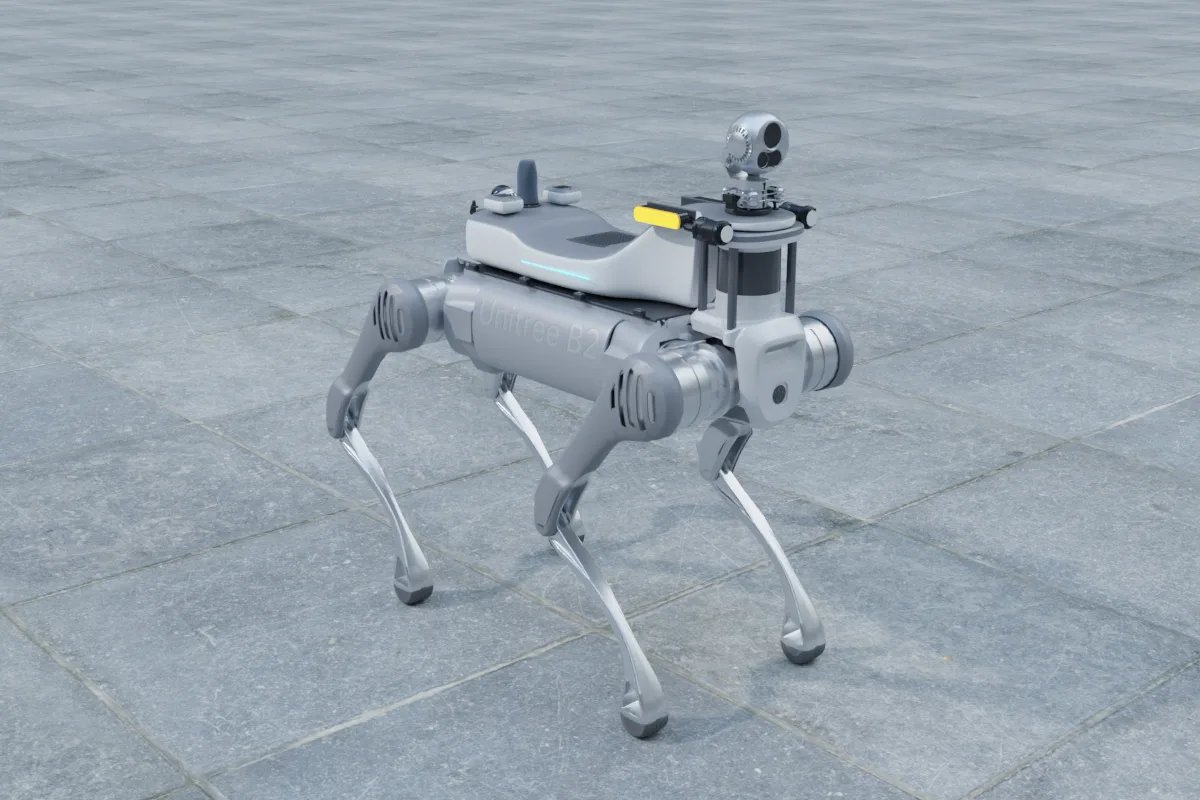
The B2 as a payload carrier
Three things make the B2 suitable. It is a 60 kg class robot with a continuous walking payload in the tens of kilograms, so a 10 kg payload does not change how it walks or climbs. Its top surface is flat and long, with mounting rails, Ethernet and a payload power port, so a payload can be bolted on without machining the robot. And its SDK exposes motion commands, state and the built-in sensors, so the payload computer can drive it on a planned route and read its battery and position.
The runtime with a payload is a working morning of rounds; with an automatic charging dock and a return-to-dock routine the robot runs several rounds a day without an operator touching it.
What goes on the payload
A substation or plant inspection payload for the B2 carries, front to back:
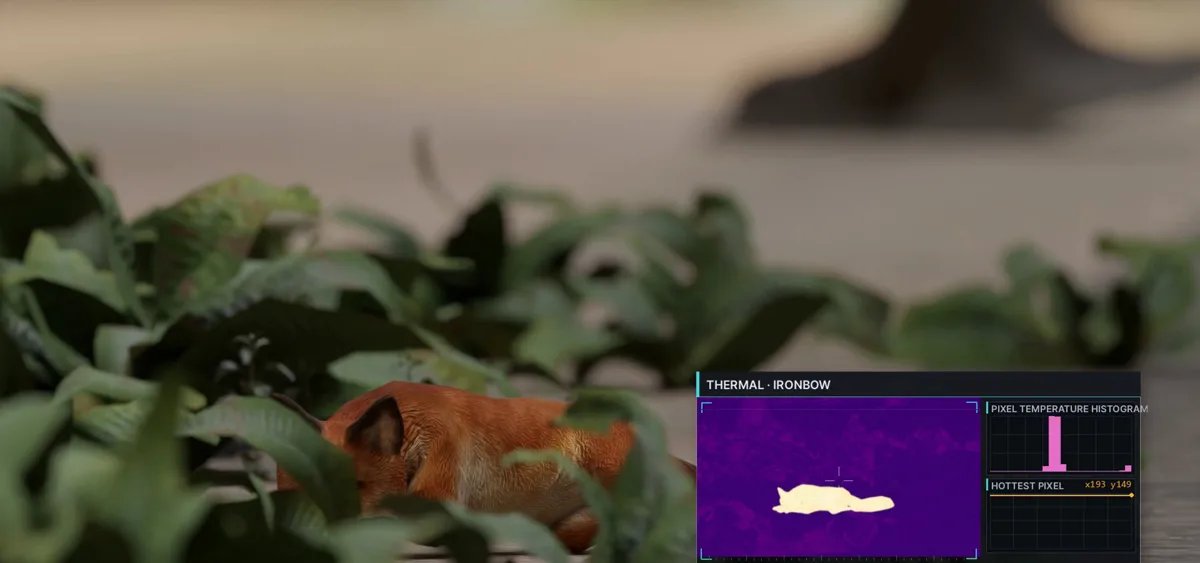
- Sensor head on a two-axis pan-tilt unit: a radiometric thermal camera (640 by 512 class) with a visible zoom camera for gauge reading, and an acoustic imager for leaks and partial discharge. The head is 2 to 3 kg.
- Sensor bay: a pumped gas sampling block with the modules the site needs (SF6, O2, CO, H2S, combustible, VOC and so on), a transient earth voltage and UHF probe for switchgear, an environmental sensor (temperature, humidity, wind), and lighting for dark rooms.
- Navigation: a Livox Mid-360 LiDAR on top for mapping and localization, a depth camera at the front for obstacles, and a dual-antenna RTK GNSS receiver for outdoor position and heading.
- Compute and comms: an industrial compute module (NVIDIA Jetson Orin NX class, or a Rockchip RK3588 module where export rules require it) running the inspection software, a 5G module and Wi-Fi.
- Power: a 48 V 20 Ah battery pack with a BMS and a power distribution board that feeds every module at its own voltage.
- Shell: a CNC aluminium enclosure with sealed glands, a conductive path from the compute module to the shell, and the mounting plate for the B2's rails.
Complete, this payload is 9 to 12 kg depending on the module list, draws 60 W typical and about 110 W peak, and sits with its centre of gravity over the B2's hips because the battery and compute are in the body section and only the head is forward.
Mounting and cabling
The payload mounts to the B2's top rails with a single machined plate; nothing on the robot is modified. The plate carries vibration isolators under the sensor head and the LiDAR, and the shell bolts to the plate so the whole payload lifts off as one unit for service. Cables to the robot are two: Ethernet to the B2's computer and, where used, the payload power port. Everything else stays inside the shell. The head's cables run through a service loop sized for the full pan and tilt range, and the gas intake is a short tube at the front, low, with a filter that can be changed without tools.
Antennas (RTK, 5G, Wi-Fi) go on short masts at the rear corners of the shell, away from the LiDAR's field of view and from the acoustic array. The LiDAR sits on top at the rear, where it has a clear 360 degree view over the head.
Power: own battery, not the robot's
A full inspection payload runs from its own 48 V pack. The B2 keeps its rated runtime, a payload fault cannot drain or disturb the robot, and the payload stays on, logging and communicating, while the robot sits on the dock. The pack and the robot are charged together at the dock; the payload battery charger ships with the payload, the B2 charger with the robot. A lighter payload (LiDAR, depth camera, compute) can run from the B2's payload port instead and skips the battery, which saves 6 kg.
What the software does
The payload computer runs the inspection application; the B2 runs its own gait and balance. The application:
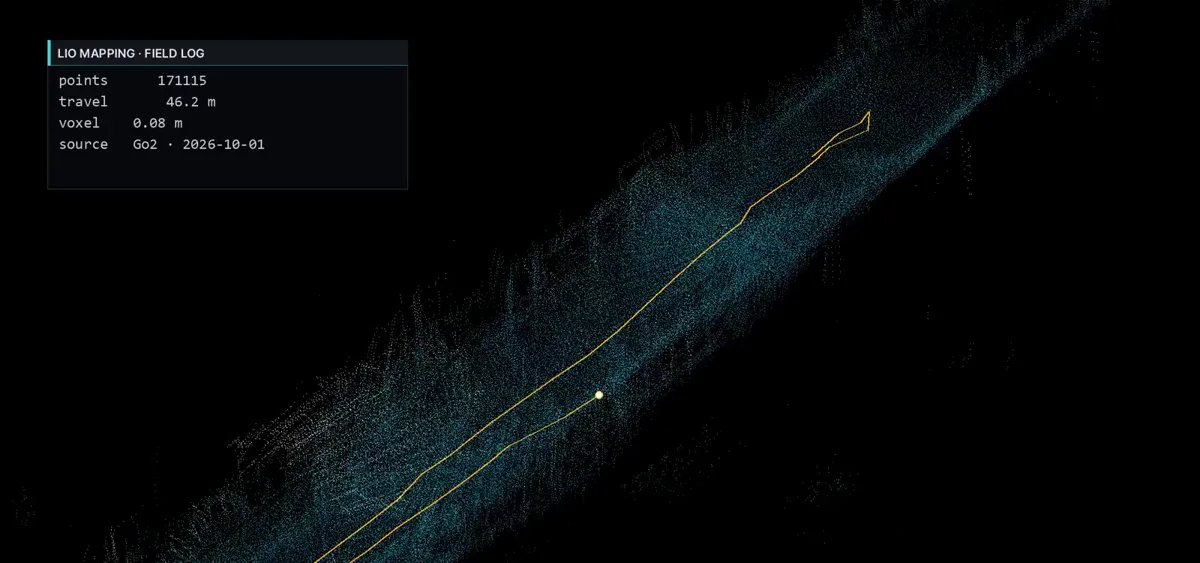
- builds the map of the site from the LiDAR and localizes the robot on it, with RTK outdoors;
- plans rounds as sequences of named inspection points, each with the head angles, the sensors to read and the thresholds for that point;
- at each point reads the thermal image against reference regions, reads gauges and indicators from the zoom camera, records acoustic, TEV and gas readings, and stores everything with pose and time;
- grades alarms and trends readings across rounds, so a slow rise at one point is caught early;
- returns the robot to the charging dock and resumes rounds on schedule;
- runs on the robot and on a server at the customer's site, with no cloud dependency, and pushes reports and events to the customer's asset management system through an API.
Variants
The same payload design is built for the DEEP Robotics X30 with a different mounting plate and cable set, and in a lighter form (no acoustic imager, smaller battery) for the DEEP Robotics M20. On the B2 itself, the module list changes with the site: a tunnel payload drops the SF6 module and adds lighting and methane; a plant payload adds hydrogen, ammonia and VOC modules; a security patrol payload replaces the gas block with a speaker and strobe. The shell, head and software are the same.
Acceptance
We test every B2 payload against a written factory acceptance plan before it ships: mass and centre of gravity, power at peak, a thermal reference (black body), a gas span check with certified test gas, a partial-discharge simulator, a gauge reference set, a wet round, a stair and slope round with the payload fitted, dock return, and the API link. The same plan is repeated on site after commissioning.
If you have a B2 and a site, or are deciding between a B2 and another robot for an inspection task, send us the site type and the equipment list and we will tell you what we would put on the robot and what it would weigh.
FAQ
How much payload can a Unitree B2 carry on an inspection round?
Unitree rates the B2 for tens of kilograms of continuous walking payload. We plan inspection payloads at 9 to 12 kg complete, which leaves margin for stairs and slopes and for a later addition such as a lighting module or an arm.
Does the inspection payload use the B2's battery?
No. A full inspection payload runs from its own 48 V 20 Ah pack with a BMS, so the B2 keeps its rated runtime and a payload fault cannot affect the robot. Lighter sensor sets can run from the B2's payload power port.
How does the payload talk to the B2?
Over the B2's Ethernet connection to its onboard computer, using Unitree's SDK for motion commands and state, and a separate link from the payload computer to the operator's server over 5G or Wi-Fi. The payload computer plans the route; the B2 handles balance and gait.
Is the payload weatherproof?
The shell is sealed aluminium with glands and a conductive thermal path for the compute module; the sensors keep their own ingress ratings. The B2 itself has an ingress rating from Unitree; the combined system is used outdoors in rain and dust and the acceptance test includes a wet round.
What is the difference from a Go2 EDU payload?
Mass. A Go2 EDU carries 2 to 3 kg of sensors with no battery and no gimbal of its own; the B2 carries the full set with a pan-tilt gimbal, acoustic imager, gas block, lighting and its own battery. The software is the same; the B2 payload is simply the complete version.