DEEP Robotics Lite3 payload integration: what fits on a 12 kg quadruped
Updated 2026-11-03 · YUANZHI ROBOTICS engineering team
The Lite3 is DEEP Robotics' small quadruped: about 12 kg, stairs and slopes, an ingress rating, a flat back and a computer the user can program. It sits in the same class as the Unitree Go2 EDU, and the same question comes up for both: what can you actually put on it? This guide gives the payload limit, the mounting and electrical interfaces, the sensor sets that work, how the software is deployed, and where a Lite3 stops and the larger M20 and X30 take over.
The platform
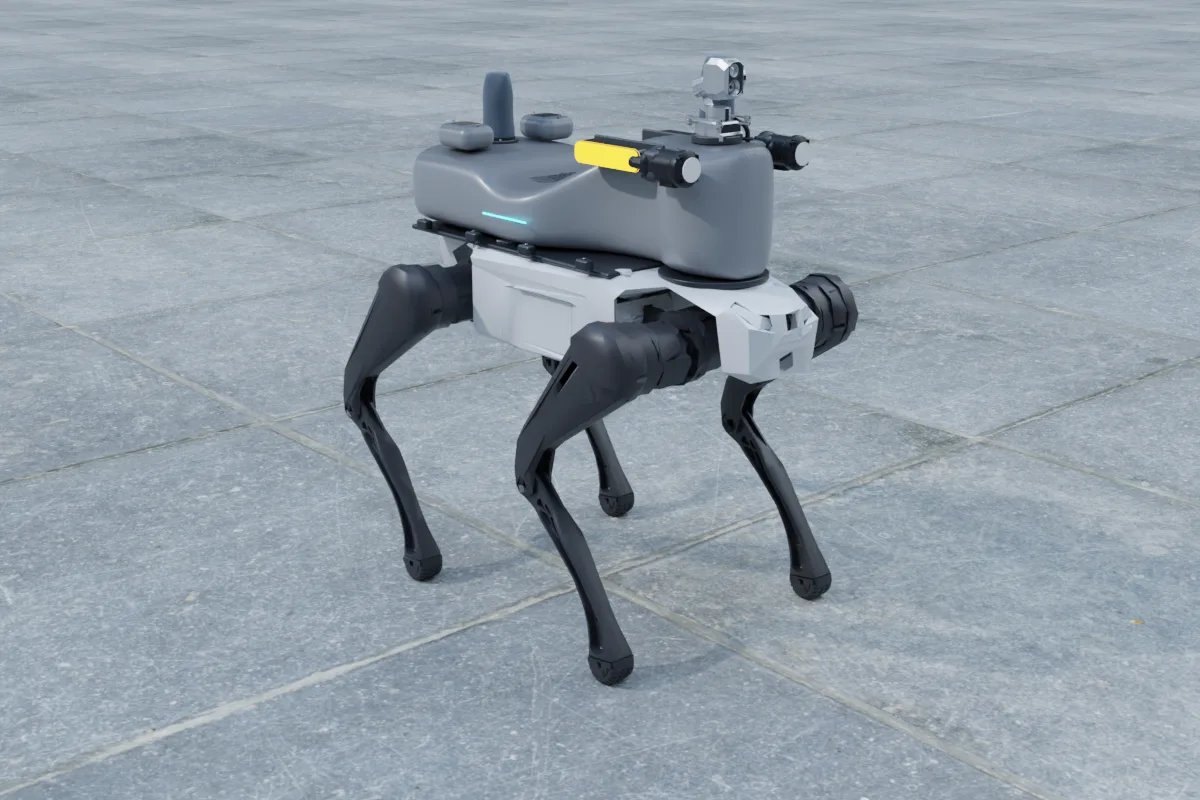
The Lite3 weighs about 12 kg, walks at up to about 2.5 m/s, climbs stairs, and runs for an hour or two depending on load and terrain. It has an onboard computer accessible to the user, a power port on the back and Ethernet, and a ROS-based SDK for motion commands, state and the built-in sensors. The back is a flat plate with threaded mounting points, which is the best starting point a small quadruped can offer for a payload. Its continuous walking payload is a few kilograms; the static figure on the datasheet is larger and should not be used for planning.
The mass budget
We plan Lite3 payloads at 1.5 to 2.5 kg including structure, cables and any payload-side battery. That keeps stair climbing and recovery from slips reliable and leaves the robot's own balance margin intact. The mass sits as low and as central as the sensors allow: the compute and any battery in a shallow shell on the back, the LiDAR on a short mast at the rear of the plate where it sees over the robot, the depth camera at the front edge looking forward and down.
Sensor sets that work
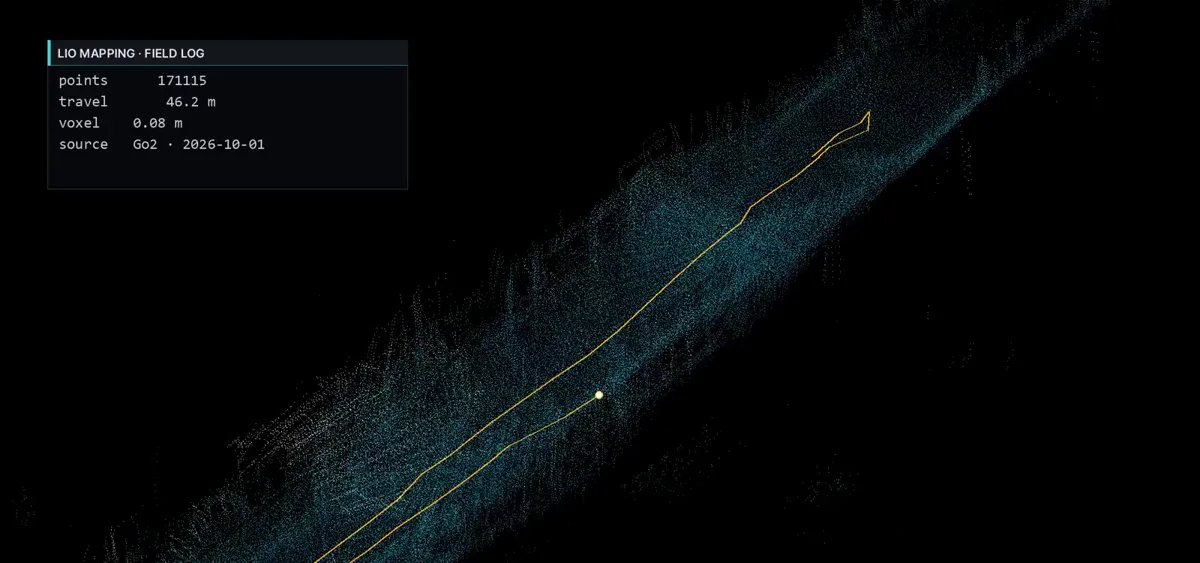
- Mapping kit: Livox Mid-360 LiDAR, Intel RealSense D435i depth camera, a Jetson Orin Nano or the robot's own computer, Wi-Fi. About 1.5 to 2 kg. Builds maps, localizes and navigates autonomously, records point clouds; the usual research and education payload.
- Light inspection kit: the mapping kit plus a 256 by 192 radiometric thermal core and a visible camera on a fixed or single-axis tilt mount, a 4G or 5G module and a single-antenna GNSS receiver. About 2.2 to 2.5 kg. Reads thermal images at named points and streams video; suited to indoor plant rounds and trials.
- Research add-ons: a second depth camera, an IMU breakout, a microphone array or a small manipulator (a few hundred grams) in place of the thermal camera.
What does not fit: a two-axis pan-tilt gimbal with a 640 by 512 thermal camera (2 to 3 kg on its own), an acoustic imager, a pumped gas block, a 48 V payload battery, lighting beyond a small LED. Those belong on the M20 and X30.
Mounting
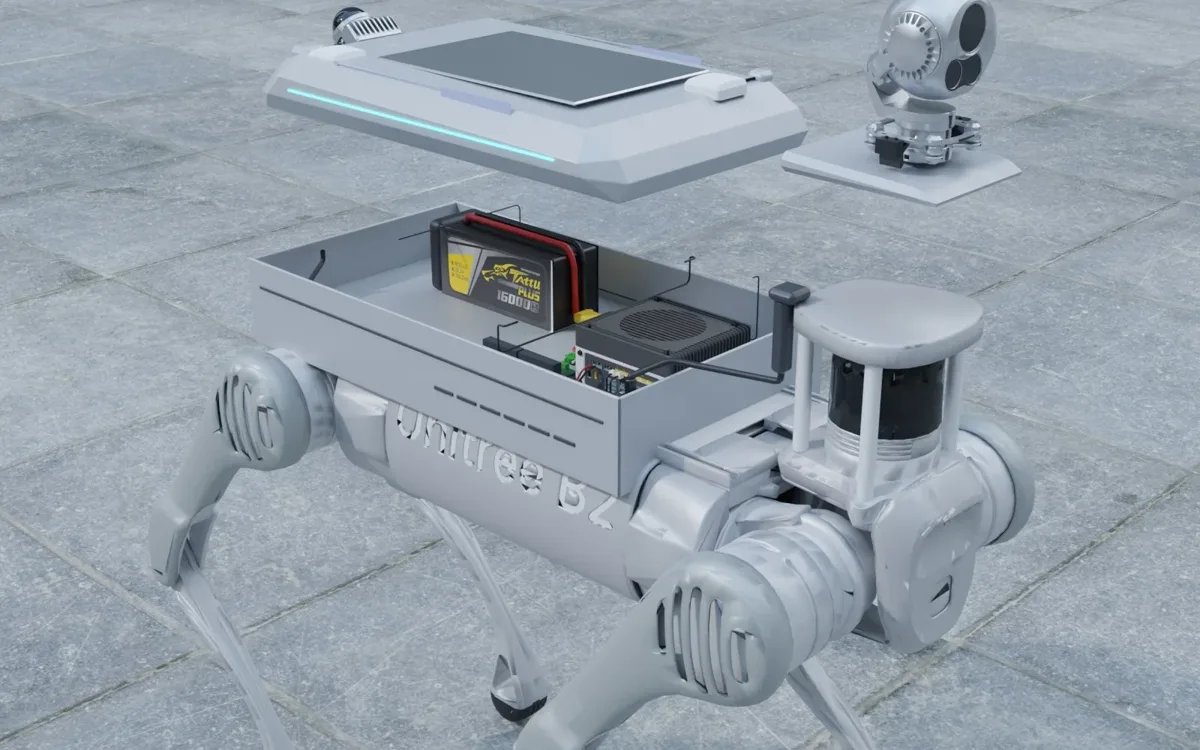
The payload mounts to the Lite3's back plate on a single adapter plate, so it comes off as one unit. The shell is 3D-printed or thin aluminium, with the LiDAR and camera on isolators, and the cable to the robot's power and Ethernet ports is a short jacketed loom with locking connectors. Nothing on the robot is modified. Antennas for 4G and GNSS go on the rear corners, clear of the LiDAR's field of view. Because the Lite3 has an ingress rating of its own, the payload shell is sealed to the same practical level (IP54 to IP65 depending on the sensor set) so that the robot's weather capability is not lost by what is bolted on top.
Power and compute
The Lite3's payload port supplies the mapping kit directly; the light inspection kit draws about 20 to 25 W peak with the thermal core and 4G module and still fits within the port's rating with margin. A payload-side battery is not worth its weight on this robot. For compute, a light stack (LiDAR driver, SLAM, one camera stream) runs on the robot's own computer; anything with a detection model or two camera streams gets a Jetson Orin Nano in the payload, powered from the port, which keeps the robot's controller untouched and lets the payload move to another robot without porting.
Software
The payload runs Ubuntu with ROS 2, the LiDAR and camera drivers, a LiDAR-inertial SLAM stack and our navigation and inspection application: map building, named points, routes, thermal reading at points, video streaming and recording, and a browser interface on the robot's Wi-Fi or over 4G. The DEEP Robotics SDK provides motion commands and state. The same application runs on the M20 and X30 payloads, so a customer who starts on a Lite3 for trials keeps the software and the point definitions when moving to a larger robot.
Where the Lite3 stops
The Lite3 is the right robot for research, teaching, indoor mapping, demonstrations and light trials of inspection. It is not the robot for daily industrial rounds: it cannot carry the full sensor head, it has no dock for unattended operation in the way the larger platforms do, and its runtime with a payload is short. When a trial on a Lite3 turns into a deployment, the move is to the M20 (mid-size, carries most of the inspection set) or the X30 (full set, dock, longer runtime), with the same software and the same point definitions.
If you have a Lite3 or are considering one and want to know what payload fits your use, send us the sensors you have in mind; we will tell you what fits the mass budget and what would need a larger platform.
FAQ
How much payload does the Lite3 carry?
A few kilograms of continuous walking payload. We plan Lite3 payloads at 1.5 to 2.5 kg of sensors and structure, which keeps stairs and slopes usable and leaves margin for the robot's own balance.
What sensors fit on a Lite3?
A Livox Mid-360 LiDAR, an Intel RealSense depth camera, a small thermal core (256 by 192 class) with a visible camera on a fixed or single-axis mount, a 4G or 5G module and a GNSS receiver. A pan-tilt gimbal, an acoustic imager or a pumped gas block do not fit the mass budget.
Can the payload run on the Lite3's own computer?
A light stack (LiDAR driver, SLAM, one camera) can run on the robot's computer. For more than that we add a Jetson Orin Nano in the payload, powered from the robot's payload port, which keeps the robot's controller untouched and moves the payload to another robot without porting.
Is the Lite3 suitable for industrial inspection?
For light indoor inspection and for trials, yes. For daily rounds with thermal, visible, acoustic and gas sensing, a pan-tilt head and a dock, the M20 or X30 is the platform; the Lite3 cannot carry that set.
How does the Lite3 compare with a Unitree Go2 EDU for payloads?
They are close: both carry 2 to 3 kg, both expose an onboard computer and a power port, both have ROS 2 SDKs. The Go2 EDU has a larger community and more third-party mounts; the Lite3 has an ingress rating and a flatter back for mounting. The same mapping and light inspection payloads are built for both.